Showing posts with label Mt. Wilson Observatory. Show all posts

Tuesday, July 17, 2012

The Return to Mt. Wilson

This blog is a follow up to my series I did about Mt. Wilson Observatory about a year ago. At the end of November I went back to Mt. Wilson Observatory, but this time it was by car making it an easier trip on the legs this time around. It was done on the final weekend of the season where the public can still access it. The purpose of this visit was to take the tour of the place with a docent.

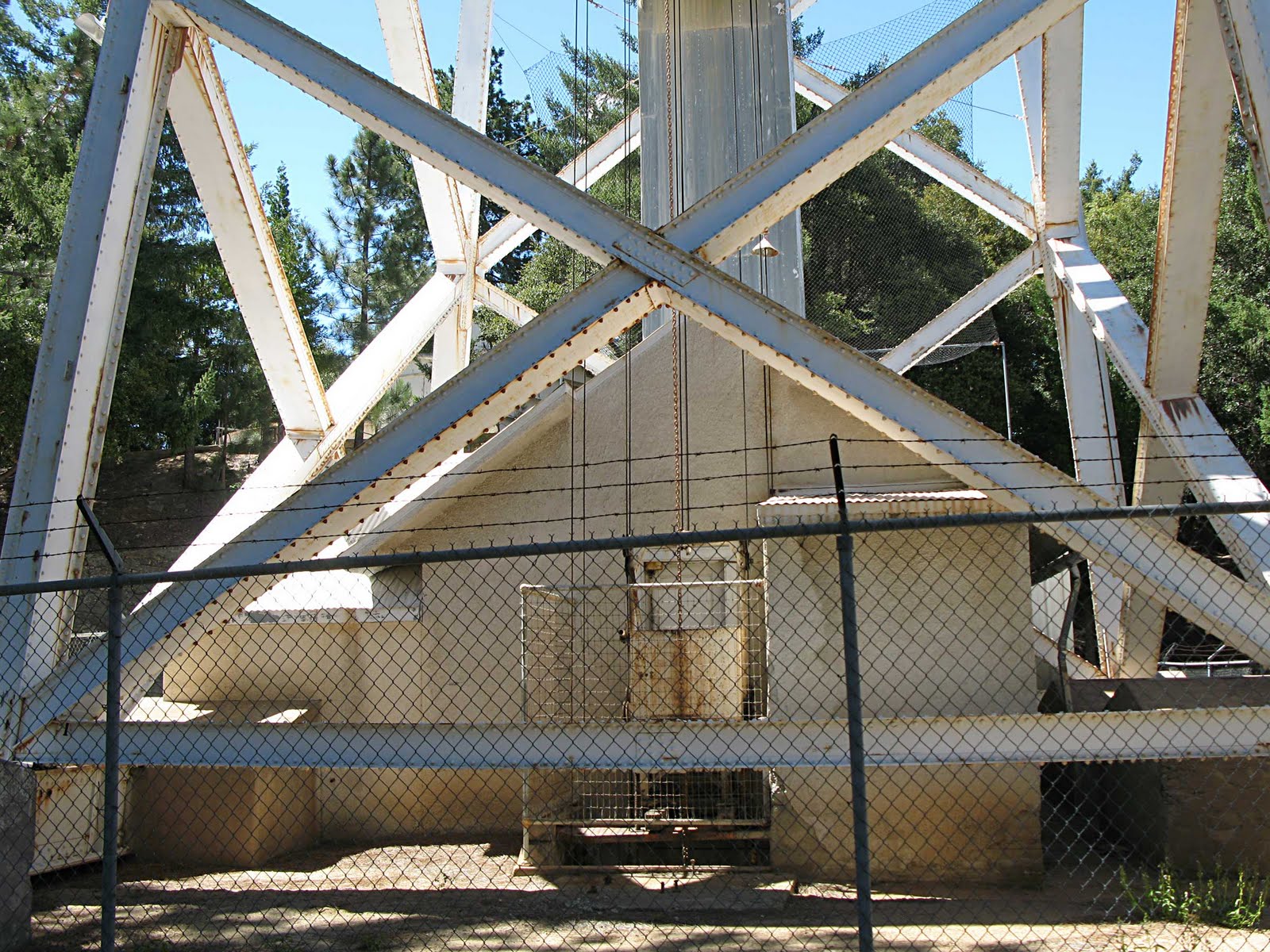
We visited the 150-ft solar telescope by going inside the small room they have there for it. This is where they take readings of the sun through the scope. The machine they have moves it back and forth capturing the whole sun.That circle you see goes back and forth. It gets readings of the solar happenings, like black spots.The tour lasts about two hours and the docent covers everything, but the main event is the trip to see the 100-inch Hooker telescope. This is the bottom of the telescope up close. If you look in from one of those bottom holes you can see that green glass that is the base of the big mirror.These are the controls to the finder scope.Looking at the top from below.It was really fun seeing this stuff from the inside rather than behind the window I had to view it from last time. You have to take the tour to access the inside.

There were a couple of things that came up the docent answered that made more sense to me after this tour. The first thing was that the "Hubble Chair" that is on what is called the "Diving Board" was essentially a "prop" that really was never used to view the telescope. The user of the scope would be on that platform sitting down rather than being in a chair. If you go back to the historical picture I showed in that series of blogs you will see Hubble and James Jeans sitting like they would have rather than using a chair.

The second thing mentioned was someone asked where the eyepiece would have been to allow the viewer to see whatever was being viewed. This was something that puzzled me as well. The docent said that early on that might have been the case when the telescope was first being used, but the whole point of it was to take pictures of the night sky. So, it was a case of lining it up with whatever needed to be viewed and then let the picture be taken of the night sky. Most amateur astronomers use various eye pieces for their telescopes, but this was not the case here.

The Return to Mt. Wilson (Youtube Version)

This blog and the previous blogs on Mt. Wilson Obsevatory can be found by clicking this link.

Finally, to visit the observatory grounds by car you need an Adventurer's Pass to park on the grounds. Also, the Cosmic Cafe is open on weekends during the season the public can access the place. You can buy food here, merchandise, and tour tickets.

Monday, June 27, 2011

The Mt. Wilson Observatory: Albert Michaelson's Interferometer

The last thing I did before I made my descent was to check out the CHARA exhibit hall. Inside it they have the interferometer that physicist Albert Michaelson helped develop. This 20-foot device was placed on top of the 100-inch scope. The mirrors combined to produce a higher resolution. Interferometry is the big word, but for our purposes the goal of this device was to determine the diameter of stars. The room was too small to get a whole picture of it so I had to stitch two pictures together:One example of this that I mentioned in the video was the diameter of the red giant star Betelgeuse. During the winter months you can easily see the constellation Orion in the sky. It is well known and even mentioned in the book of Job (9:9 and 38:31) in the Bible along with the Pleaides which is the group of stars that you can barely see at the very top of this next picture. The following is a screen shot from the Stellerium program that shows Orion. I zoomed into Orion. The constellation is supposed to be the mighty hunter Orion. His "belt" is the three stars in the middle. The tip of his dagger below his belt is where the Orion Nebula is. Betelgeuse is where his right shoulder is.On December 13, 1920, With the use of the interferometer, they were able to determine the diameter of the star. They found out that if you were to place Betelgeuse where our sun is it would engulf all the planets out to Jupiter. So, we are talking at least beyond the orbit of Mars to the orbit of Jupiter. In any case, it is VERY BIG!

After this I went back to the water fountain one more time. Then I started the trek down. In a few hours I made it back to my car and got home safely. The one thing I was a bit concerned about is that I had heard that you can encounter rattlesnakes on this trail. My concern is if one were on the narrow trail I would have a hard time getting around it. It was warm enough on the way down for one to be on the trail. That never happened, but a ton of lizards were running around.

One thing about Mt. Wilson during that day was it was very quiet, and there were few people walking around. Those people probably worked there, and I may have been the only visiter there that day. There are areas marked off that are clearly private and tell you not to go there because the astronomers are sleeping. The one area I had hoped to get to was the speed of light experiment area that Michaelson did his famous test to determine the speed of light. Unfortunately, that is in one of the areas the public is not supposed to go to even though they have a few markers at the spot. I probably could have used my silent skills to get there without causing problems, and I know some have, but out of respect for the history of the observatory I did not do it. It is one thing when museums that take your money will not allow you access to things like this, but since the observatory is free to visit I wanted to be extra respectful about following the rules that have.

Einstein Was Here! (Youtube Version)

Ocean of Clouds at Mt. Wilson (Vimeo: some alternative footage I shot for the ending of my hiking video. It is kind of interesting because they were flying in the parts via helicopter.)

Stellerium (The free program I used for the two pictures above. I highly recommend getting this if you have any interest in the night skies.)

Mt. Wilson Observatory (Official Site)

Again, books and other printed material are the best to read about all these topics, but just as a starting point:

Albert Michaelson (Wikipedia article)

Astronomical Interferometer (Wikipedia article)

Mt. Wilson Observatory Association Booklist

Thursday, June 23, 2011

The Mt. Wilson Observatory: The 100-Inch Telescope

(GPS: N34° 13.545 W118 03.430)

Last time I was crossing the bridge to get to the most famous telescope at the observatory. There are many plaques with signs about each scope around the observatory. There is usually a timeline, pictures of discoveries by the scope, write-ups of the important discoveries, and a "blue print" of the telescope. This is part of the one for the 100-Inch Telescope.From the bridge you just go to your left and around the corner in this following picture. Then there are two open doorways. You can go up either one because it gets you to the visiter room to view the telescope. In the video, I kept walking up the stairs just because I liked the effect of it, but no need to post pictures of them here.This telescope is known as the Hooker telescope because Joseph Hooker was the one who invested the money into making it. What happened in astronomy during the late 19th and 20th centuries is scientists were dependent on very wealthy philanthropists to donate and invest in observatories and their telescopes. Observatory director George Hale had to spend much time lobbying for funds rather than spending all his time doing more scientific research. Hale was always pushing for bigger telescopes. After the 60-inch scope he wanted a 100-inch telescope built. In around 1906, the 100-inch mirror was okayed for production in France. It was finished in 1908 and sent across the Atlantic. When it finally arrived Hale and others examined it with great anticipation. Unfortunately, there were bubbles in the disk and the glass was fused. This was a major let down since they realized they would not be able to use it. After thoughts of getting a new mirror, Hale decided it might work after all. So, he had the mirror grounded and polished in 1910 and finished in 1916. It was finally taken up the dirt road to Mt. Wilson on July 1, 1917. The telescope was ready and first used in November of 1917. However, due to World War I, the scope was not really used until after the war was over.What you see above is the bottom part of the telescope. The 100-inch mirror resides there. It is a reflecting telescope in that it captures the light and reflects it off the mirror for viewing. The picture below is just looking straight up the frame of the scope.
In the following picture, Edwin Hubble is on the left and James Jeans is on the right. There is a chair, known as the Hubble Chair, that can move into place to view the telescope. The scope, the dome, and the chair can move into place to view whatever part of space needs to be viewed.There is the Hubble Chair. You can see how it would movie into position. Essentially, it is the same scope that went up on 1917. I am sure there have been part replacements, etc., but the mirror and what you see is the same.There is where the dome can open up.
As I mentioned last time, the prevailing view was that the only galaxy that existed was our Milky Way Galaxy. What people believed they were seeing through telescopes were only nebulas that existed in our own galaxy. Harlow Shapley was a leading advocate of this point of view.

Edwin Hubble began using the 100-inch telescope in the 1920's. He favored the alternative hypothesis of the time that we are part of an island universe where there are many galaxies beyond our own out there in space. The problem was that during this time there was no way to gage the distances on how far these nebula were away from earth. On October 4, 1923 he was doing his nightly routine of taking pictures of various nebula when he took a picture of the "Andromeda Nebula". Hubble examined the picture later and noticed a new speck of light in the nebula. He indicated it was a nova. Then, while going through old pictures back to 1909 of the same spot he determined he had found a variable star. Not just any variable star, but a Cepheid variable star. This type of star changes its luminosity in a cycle over a period of about a month in such a way that it can be used as a "standard candle" in astronomy. Basically, a common analogy is, if you know you have a 100-watt lightbulb you can measure its brightness to determine how far away it is from you. The further it is away from you the dimmer it will be, but you can measure that based on your knowledge of how bright it would be a few feet from you.

Hubble ended up finding more Cepheid variable stars and had definite evidence that the spiral nebula they were seeing were not nebula after all, but were much further beyond our galaxy. The Andromeda Nebula was really a galaxy itself: the Andromeda Galaxy. So, from this discovery at this telescope we found out that we are just one galaxy among many in the universe.

The second discovery was done years later. By 1929, Hubble, with Milton Humason, had determined the distances to 24 galaxies. They noticed the galaxies were red shifting. By measuring the velocities of the galaxies they found out that the velocity increased the more distant the galaxy was. A galaxy 10 million light years away travels twice as fast as the galaxy 5 million light years away. Basically, the galaxies were moving away from each other at great speeds. This was the evidence that our universe is expanding, and was the foundation for the Big Bang Theory about the beginning of the universe.

I'll cover one more item at Mt. Wilson Observatory next time as I wrap this one up.


Lots of books can be found about the Mt. Wilson Observatory, Edwin Hubble, and this telescope. A good non-technical level book is Marica Bartusiak's The Day We Found the Universe. She gives all the background history needed and emphasizes that it was not just one scientist that made these discoveries, but each scientist laid down the necessary research as the foundation for the major discoveries.

Wednesday, June 22, 2011

The Mt. Wilson Observatory: Einstein Was Here!

Continuing from the last blog about the solar telescope...

I mentioned last time that when the observatory was founded in 1904 until 1919 it was known as the Mt. Wilson Solar Observatory. During that time there were three major solar telescopes here: The Snow Solar Telescope, The 60-Foot Solar Tower, and the 150-Foot one I showed some of last time. The solar was dropped from the observatory name in 1919.

I continued walking for a few minutes and passed by the dome of the 60-inch telescope dome. It is a reflecting telescope with a 60-inch diameter mirror. This telescope was completed in 1908 and was the biggest in the world at the time until replaced by a bigger one at this observatory. It is the only telescope at Mt. Wilson the general public can use for a fee.
In 1916, Harlow Shapley used the scope to determine that the M13 gobular cluster of stars is 36,000 light years from us. This showed that the Milky Way Galaxy we reside in was quite large. At that time, since they were still trying to figure out how to gage distances, it was believed that our galaxy was the only one out there. We'll get to some of the historical debate on this in the next blog. One thing to add on this is that Shapley assumed that M13 was closer to the center of the galaxy, while our sun and the earth were far away from the center. We now know this to be true.
In the above picture, the 60-inch dome is off behind the trees to the right side of the picture. The little building to the left is the "galley" where astronomers could make their meals, drink coffee or tea...more on this in a moment. However, notice that little drinking fountain next to the short stairs! I was so relieved to see that. It was so cold, and I made sure my water bottles were filled up for the hike down. I knew I would be okay going down now. See the little dome in the distance? Notice the pipes running from it to the right side of the picture? Those same pipes are in the picture below. This is just part of the CHARA (Center for High Angular Resolution Astonomy) Array. Spread throughout Mt. Wilson in a Y-formation are a total of six domes each with a telescope. Each scope has a one meter (3+ feet) diameter mirror that captures light, the light is transported through the pipes, and sent to the central Beam Combining Lab. Computers are involved lining up all the mirrors to combine with each other. This allows the Array to see as if it were a single telescope about 400 meters in diameter. It can see the fine details in stars and star systems. The concerns with CHARA are the issues of star diameters, shapes, surface tempatures, masses, distances, and luminosities. The pamphlet I got from there says it is the structural equivalent of seeing a nickel 10,000 miles away which totally blows my mind. It is run by Georgia State University. BTW, there are a bunch of universities that use the equipment at Mt. Wilson. Each doing their own projects. Here is a picture of Albert Einstein and others when he visited Mt. Wilson. In the above picture where I was at the "galley" with the drinking fountain, you just turn around and there is a bridge that takes you to the 100-inch dome. the picture below is really close to where he would have been, and there is a little plaque that notes this with above picture. They have more trees around, the bridge has changed a little, but this is where he was standing. There is another picture out there of Edwin Hubble on this same bridge at this point. Hubble will be discussed in the next blog. The deal was that George Hale was very strict about where the astronomers could make and eat their food. The risk of fire destroying the telescopes, equipment, and the whole observatory was and is still a concern. Fortunately, this did not happen during the Station Fire a few years back, but they do have large water tanks on reserve for fighting fires at Mt. Wilson. That is why Hale set up the galley and other places for astronomers to eat and prepare food.
In the next blog I will cover the 100-inch telescope that revolutioned astronomy by showing our place in the universe in the early to mid-20th century. Unlike, the other domes, we actually get to view the whole telescope through a window.

Einstein Was Here! (Youtube Version)

The Chara Array website (Georgia State University)

Tuesday, June 21, 2011

The Mt. Wilson Observatory: The Solar Telescope

(GPS: N 34° 13.480 W 118° 03.520)

This blog continues with one of the major goals I had of the hike: exploring Mt. Wilson Observatory. A few years back I was about a week away from coming to the observatory, and that was when the station fire took place that pretty much closed not only the observatory to the public, but the Angeles National Forest for most of the year. Keep in mind that it is only open to the public from April 1st to November 30th, so I was very disappointed at the time because it was something I had wanted to do for a few years. If you followed this blog during that period I was very frustrated because there were fires in Yosemite about the same time. It was one of those things that burned me out, no pun intended, because of all the training and preparation for nothing.

That was then, but when I did the Mt. Wilson Trail it was a case of killing two birds with one stone: exercise hiking on the historic trail and getting to see the observatory. The only problem is it was very dry and hot up at the top. At the end of the Mt. Wilson Trail video, I showed the direction I needed to go to the observatory. After entering I encountered the museum.

The museum is one room with walls of astronomical space pictures with explanations, a few artifacts, and a few models. I spent a little time there, but was more interested in exploring everything else. So, just turning around from the above picture I encountered the 150-Foot Solar Telescope.
The Mt. Wilson Observatory started off as a solar observatory. George Hale, the founder with funding from Andrew Carnegie, originally did much research in the area of studying the sun's magnetic properties. While most people think of astronomy as looking at stars at night, astronomers have, and still do, study the the closest star we have during the day. That is, the sun itself. So, the scientists here do work in the day and at night. What you see above is the elevator that takes one to the top of the telescope. Many famous people and scientists have gone up it. When one examines the sun with one of these telescopes, one usually sees black spots on the sun. These spots are where intense magnetic activity (aka solar storms on the surface of the sun) takes place. There is usually an 11 year cycle for the sun spots. One major focus of studying the sun and the black spots is trying to figure out the exact mechanisms cycle and what produces them.

As I write this, much is being talked about in the news about the sun going into a "solar silence" phase where there will be little sunspot activity by around 2020. If that does happen then the question will be for how long, and what does that mean for us on the earth? We have not had this happen since 1645 to 1717, almost 400 years ago. I'll let you google the news articles and link some basic wiki articles for starters below.

The solar telescopes main instrument is called a magnetograph which takes the readings of the sun. Not only does it note the sunspots, but also the rotation rate of the sun. Also, each day simple drawings of the sun are made and sent to a couple of centers in the U.S. in an effort to predict extreme solar activity that can disrupt global communications.

As for me, the sun was making itself known to me in a bad way. The hike was easy while I was under the cool clouds, but once I got past cloud level things really warmed up. The observatories drinking fountains were not working, the little water and gatorade I had was getting warm, and I started to get a little concerned about the trip back down. Without liquids on a hot hike down could lead to a very bad situation! Yet, for the sake of science I pushed myself on to the the rest of the observatory.

Einstein Was Here! (Youtube Version)

I'll say this a few times as I do this. Personally, when it comes to science I would much rather read books and articles by scientists to understand the concepts. However, Wikipedia is a good starting point, but not the be all end all of understanding, be it science or any other discipline. With that caveat:

Sunspot (wiki article)

Maunder Minimum (wiki article)