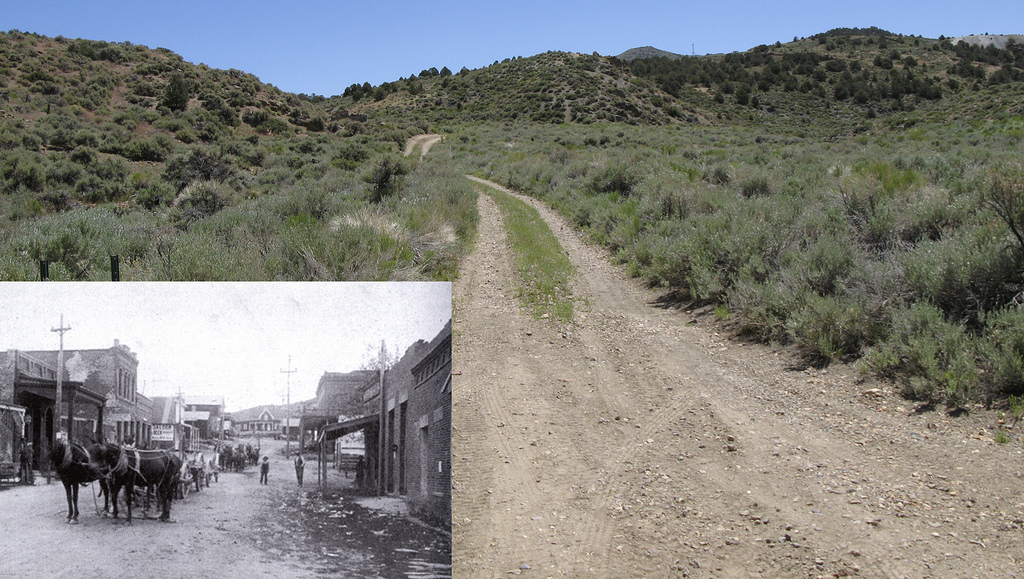
Saturday, December 10, 2011

Aurora Ghost Town (The Cemetery Cont.)

This area that is fenced in and just outside of it is called the recent or "new" cemetery. Most of the people interred here had some connection to the town beyond the boom years. Continuing from the last blog, I went through the entrance:Some of the tombstones or markers are broken or have been stolen. Some that were made of wood are long gone. There are a bunch that were solidly made like this for Mary and Henry Williams. They were natives of Ireland. who died in the early 1890's.This is Edwin Wood. He died in the late 1890's at the age of 50. His daughter Lurie Wood who died when she was six in the 1887.The following graves are some of the sad ones of which I am sure there were many more here . These graves were the children of Horace and Lizzie Marden. Hoddie Marden died in 1884. He was 18. The marker on the left is for James Marden. He was 7 years old and died of typhoid fever at Twin Lakes outside Bridgeport in 1865. As I mention in the video, I have probably walked by where he lived and died a great many times through my life since that is near the summer home. Horace did some lumbering there, and I have an idea where they would have lived. The following represents four children that died within ten days here. There was a diphtheria outbreak here in Aurora in 1878. Originally, there was a marker for each child's grave. I show a picture of it in the video. However, these days this marker has each name on each side of the marker. I kind of regret not taking pictures of each side now, but during the time I was more concerned about getting to another gravesite that will show up in a few blogs.

Just as an FYI, originally, I did not intend to do a video for most of the cemetery. I was only going to show a few gravesites on video. Since I already had an old camcorder video of most of the graves, I decided to quickly go through the cemetery with my HD cam and do quick indentations mostly for my own use. When putting together this series I changed my mind. So, to make up for the transitions of me moving from grave to grave, or if I did not like the way I moved the camera I inserted a few pictures at points. That is the why I moved around rather quickly with most of the graves you see in the video.
There are more recent internments. Some just go back to the 1980's or 1990's. For example, this one is for Clayton and Elsie Davis who died in 1987 and 1995. These more recent internments are of people that have some connection to the town.Anna, wife of J. G. Booker, was 27 years old when she died in 1896.There are more graves here, and I show some of the same and others in the video. The next two blogs will deal with the graves that are outside of this cemetery. They are part of the older section of the cemetery that was used during the boom years.

If you want to learn more about the Marden family and their tragedy then please get the following book:


A follow up book is a series of columns written for the Inyo Register by Horace Marden. Mrs. Lee adds essential annotations to the articles:

Lee, Peggy Knudsen. Tales of Aurora, Bodie, & Columbus: Written in 1915 & 1916 for the Inyo Register by Horace Marden (Crescenta: Mountain N' Air Books, 2010)

R.I.P. Aurora (Youtube Version)

Friday, December 09, 2011

Aurora Ghost Town (The Cemetery)

(N38° 17.475 W118° 54.080)

The irony of Aurora is that although the town has been completely wiped out the cemetery is a lot more preserved. In the next few blogs I will be covering the cemetery. I will survey a few markers of the ones you can find there. This one will be different than the one I did a year ago with Bodie. With Bodie I had a small pamphlet I purchased years ago that gave some notes with most of the graves. With Aurora I only know the stories of a couple of people.

Back at where we parked is that sign on the rock about Aurora that I showed in the first blog. From there the dirt road that heads north one can be walk a few hundred feet to get to what was known as St. John's Cemetery at the time. From there one starts to encounter the tombstones just off the side of the road.

This is one of the first markers you see. It is for W.M. Boring who was a Nevada State Senator. A native of Tennessee, he died in Aug. of 1872 at the age of 43 years.
Just turning to the right gets you to the tombstone for Mrs. Mary Ann Reid who was 25 when she died in Nov. of 1879. Some markers like this are very hard to read even when you are there.

Incidentally, in the video about the cemetery I made an inside joke regarding one of my relatives. When he was here with me years ago I sent him investigating near this grave. I have old lower quality camcorder footage of him regarding this, and that is why I mentioned that. For the time it was a silly thing I would show to my extended family and is why I made mention of it in the current video. Other than that, it has nothing of importance to this cemetery or anyone else...unless you know Ervin...in that case ask him. ;) Netta Pfeifer, who was the wife of F.C. Pfeifer, 1880-1906. It simply says at the bottom, "Rest".Many fenced in areas do not have any markers at all. As I get to the older section of the cemetery there would have been many graves with just wooden markers for the time. Those have long since gone. Here is one of those fenced in graves that has a tree growing right in the middle of it.Here is the main section of the cemetery. It is easy to spot, and it is fenced in. You can see there is a sign there.I'll be heading into this cemetery and showing some of the markers in the next blog. Since I am "connected" to the "silent majority" let me translate this sign by saying, "respect the graves and cemetery here".At this point I just want to mention that there has always been a "catch-22" situation with this blog that I have known from the beginning. I enjoy showing these types of places on the blog. Yet, I know that there is some danger in doing so because there is always someone that does not have the same type of respect. There are some places I have never mentioned and will not because of this.

Once in a while I will get someone that will contact me that feels the need for taking home souvenirs, or the, "I can take this home and sell this on e-bay" mentality. This irritates me to no end. Some guy contacted me a while back and thanked me for showing where a movie took place. Then he proceded to tell me that he found something from that movie's set to take home. That is NOT the point of me showing or going to places like this. Take pictures, take videos, but leave whatever you find there for others to see. Fortunately, the guy was totally clueless, and what he found had nothing to do with any movie.

If there is ever an example of the tragedy of people scavenging and leaving nothing behind then the town of Aurora is it. Of course, the town and cemetery are protected these days by Federal Law.

R.I.P. Aurora (Youtube Version)

Thursday, December 08, 2011

Aurora Ghost Town (Mark Twain)

Heading back to the the fork in the road I headed off to the left side this time. This was still considered Pine Street.Further on down. Back in the day the sides of these roads would have had small cabins people lived in.
I was just checking out this interesting crag here.The most famous resident of Aurora, although very temporary, was a young Samuel Clemens. The future Mark Twain. He came here seeking riches in mining and milling in Aurora. He only stayed for a few months in 1862. This is because he soon realized that the physical labor and investing in mining was a little too demanding for him. He was remembered for being a good story teller, and it was during this time he started to transition into his real talent: writing. He eventually moved to Virginia City to start writing for the newspaper.
In the above picture I turned around. While at Aurora, Mark Twain lived at a few places, but one place he lived at was the cabin of Tom Howland. From what I can tell, that cabin would have been really close to here.


A lot more could be said about Mark Twain's time in Aurora. He did write about his time here in his autobiography titled Roughing It. His big story in that is how he and his friends should have made big money on a claim at Last Chance Hill, but they failed to register their claim in time. Another story that was fun to read was how he got stuck on one of the islands at Mono Lake. Something to keep in mind while reading his account, Twain loved to tell a great story and was not above exaggerating to make a good story. If I have some time at the end of the month I will show something he mentions in his book that was a few miles away from Aurora.
 
This marks the end of the second phase of this series on Aurora. The third and final phase deals with the cemetery back at where I started in the first blog. That will be next.

Aurora Ghost Town: East Pine Street (Youtube Version)

Wednesday, December 07, 2011

Aurora Ghost Town (The Daly Gang)

The long one. But, if you like westerns or western history this is it.

Something to keep in mind with Aurora is that it did have it's "Wild West" moments during its boom years and beyond, but those were for a limited time. It was usually peaceful with respectable citizens. In the Roger McGrath book which I have referred to before on here, and will list below as his book as the best on this part of Aurora history, only lists seventeen persons as the victims of homicide that can be verified. He does note that records are incomplete, and the number could be in the thirties based on a grand jury statement found in a newspaper at the time. Those homicides would have been during the boom years of the town, but it was during the period of about a year that a group of professional gunmen were hired that were the cause of a bunch of killings. They were known as the Daly Gang.

The following picture was taken around 1890 from a highpoint overlooking the northwestern part of town. The highpoint peak (Lover's Leap) was shown in earlier blogs, and the road I came down to the town from had a road that splits of to the west that leads to it. One of the things I wanted to do is take an identical shot of this picture from that highpoint, but ended up not doing it. There is always next time. :) In any case, this picture only reflects about 1/4 of the amount of buildings there were during the boom year period. The structure at the top is the Real Del Monte hoisting works building. It is on top of Last Chance Hill which is an important mining location for history in this blog entry.
Continuing from the last blog, I headed east along Pine Street until the road forked. I took the road to the right that was actually known as Wide West Street in Aurora. The next blog will cover the road to the left.

In the distance, up on what is part of Last Chance Hill, is a mining type of mound that is where the Real Del Monte Mining Co. hoisting works was at. I mentioned this above with the historical picture.
As I show you this mining area in the following pictures I want to give you some of the history of the Daly Gang. A young man in his mid-20's, John Daly, arrived in Aurora sometime early in 1863. He was already known as a gunfighter from Sacramento before arriving here. One of the key events that was already on his mind that played a big part in his downfall later on was that a friend of his was killed in Sweetwater Valley outside of Aurora. His friend stole a horse and was killed by a man to get the horse back, but the station keeper, William Johnson, would not tell Daly who killed him. Daly was very angry about this and wanted to avenge his friend. He would not forget about this incident.
Meanwhile, there was a dispute between the Real Del Monte Mining Co. and The Pond Mining Co. over claims on Last Chance Hill. A legal battle was going on, but both sides hired gunmen to protect their interests. John Daly and his friends were hired as the gunfighter enforcers for the The Pond Co. Not only were they to protect The Pond's interests, but to intimidate witnesses and the opposing company executives. They were known as the Daly Gang.
To achieve more power, Daly had one of his men voted in as the City Marshall during the election. This created an interesting situation. Daly and his men were now running around as law enforcement marshals. The criminal element of town had taken over as the law, but the average citizen was relatively safe. As was fairly typical of old west towns, as long as the rough crowd fought against each other no one cared, but if someone respectable was killed then the town would rise up against the individuals.

The Daly Gang had pretty much taken over the town. Although I like to compare this to the situation in the movie High Plains Drifter being as it was filmed not too far away, most of the citizens continued their daily lives without fear. While the average citizen was safe from criminal activity, the vices of an old west town did increase during this period. This is because the Daly Gang began collecting protection fees for themselves that allowed for more gambling, prostitution, public drunkenness, and fighting. So, they were acting more like gangsters than law enforcement officers during this time.
The above picture is looking at where the Real Del Monte hoisting works building would have been that I mentioned earlier.

Eventually, in the early part of 1864, a second trial between the two mining companies reached a hung jury. It was then that a settlement was reached between the two companies. Because of this there was no longer any need for hired gunman. So, the Daly Gang was no longer employed by the company. Meanwhile, while John Daly was protecting his clients during the trial in Carson City, a new marshal was elected. This new marshal fired all of Daly's men and created a new police force.

John Daly and his gang really had no reason to stay in Aurora anymore. However, there was one vendetta that had not been resolved in Daly's mind. That was the issue regarding William Johnson not telling him who killed his friend a year earlier. Since the name was never revealed to Daly that meant Johnson was going to have to pay for the killing since he was the one covering it up. He was now the target of the Daly Gang.

Johnson showed up in Aurora selling some potatoes that he had grown near his station. Members of the Daly Gang noticed him in town and started stalking him. That night Johnson was befriended by members of the gang at the Merchants' Exchange Saloon (part of the hotel). Note that this is the incident I was thinking of, and the place I refer to, in the previous video when I mention they committing a murder here, but this is just where they met up with Johnson. By the time the saloon had closed, Johnson had been drinking and gambling with the men. They took him to another saloon.

After 4:30 a.m., Johnson started walking down the street. As he was walking up Antelope Street near the post office, he was attacked by William Buckley, Three-Fingered Jack, James Masterson, and John Daly. Daly shot him through the head clearly killing him, but Buckley made the deed absolutely certain by slashing his throat with a bowie knife.

In one of the first blogs on this I showed a picture of Antelope Street heading south. I am going to say that the incident took place maybe 50 feet (?) or so down the road of where I was standing. You can right click and open in a new tab to see this picture HERE.

As I mentioned earlier, when the gunfighters killed fellow gunfighters no one cared, but once a respectable person was killed then the town rose up. That is what happened here. The town went into a panic and quickly formed a "Citizens' Safety Committee" at Wingate Hall.

A few complications arose during all of this, but the main one was that William Buckley escaped the town. Two posses were sent out after him. Four days later he was found near a cabin where Rush Creek enters Mono Lake. For you movie fans, yes, this is very close to where Lago was in High Plains Drifter. Also, Rush Creek is connected to that Gem Lake hike I did last year in November.

Back in Aurora the town was now under marshal law. Fearing that Daly and the men would escape justice if they were sent to Carson City to be judged in court, they decided to act. The four men were hanged on February 9, 1864 in front of Armory Hall above town. The next day Governor Nye, a U.S. Marshall, and a few others arrived. They were disappointed to see vigilante justice had happened, but the town was very quiet and orderly.

Summing this one up, the Daly Gang rose quickly and then had a quick decline in about a years time. After they were over with, the town went back to being a peaceful. At this point, the Aurora was beginning to decline as the final year of its mining boom.

Most of what I described here is based on the Roger McGrath's book which covers the violence in the towns of Bodie and Aurora. Chapter five is the one that details the history of the Daly Gang. Obviously, he goes into a lot more detail. It is highly recommended:

Mcgrath, Roger. Gunfighters, Highwaymen, & Vigilantes (Berkeley: University of California Press, 1984)

In the next blog, I will cover the most famous resident of Aurora.

Aurora Ghost Town: East Pine Street (Youtube Version)

Tuesday, December 06, 2011

Aurora Ghost Town (East Pine Street)

For the next couple of blogs I will show you what the other side of Pine Street is like these days and give you more of the history of the town. This is looking toward the east side of what would have been the main street of Aurora.Near the point I am at there would have been a flagpole with the American flag. On the left side closest to me would have been the Gem Saloon. Further on down would have been places like the Wingate Saloon and the jail. Just to my right would have been the location of the Exchange Saloon.

Keep in mind this is different than the Merchants' Exchange which also had a saloon. One correction that I think I need to make here is that I think the gunfighter William Carder was actually killed here and not where I say in the video about the Merchants' Exchange. Although, the irony is I was probably standing a lot closer to where he was killed with my back within feet of the Exchange Saloon site. There is some ambiguity on this in the books I have. Then you have other saloons with similar names too. Carder will come up again in this blog at a later time. I'll explain a little more as to why I made this mistake at that time, and if I find out anything different I will re-edit this.

The superintendent's house would have been in the background near where the road forks...we will get to that...for now you can see it in the background in the historical picture I put in this one:
Moving to the east and then looking north is what I was referring to in previous blogs as the craggy cliff. The armory I was referring to in earlier blogs would be above that, but I think it is more to the right side of the picture. Again, it was overlooking the town in order to protect it.
Moving more to the east, but then turning around and looking west gets us close to the courthouse. That would have been close to my left, and that is the courthouse remains for that time on the left side in the historic picture below. The courthouse actually turned into a hotel later on.


Let me say this now that in the video for this part that I was really close in mentioning where some of those buildings were by the courthouse, but had I done that video now I probably would have had it a little more fine-tuned than how I describe it. It's nothing that most people would care about, but the depth of how far things are away is a little more complicated here. It is not like the Alabama Hills where I have the background, rocks about half-way, and then close-up rocks. Aurora does not give me much to work with. This is mostly using a background and then an annotated map. Maps like the one I was using just give you some guidelines at a place like this. I am not saying it's impossible. It's just more complicated compared to something like the Alabama Hills.

This following picture is looking more to the left to show you where a lot of people would have been living. Again, it drops and has short inclines. Most of the other roads of the town would be over that incline. The remains of other homes, the schoolhouse, stores, and churches can be found out there, but I decided to stick with the mainstreet for this one. There is always another trip. :)

After walking a little further to the east one comes across this shack.
This shack seems a lot more "modern" than the era I have been talking about.
In the next two blogs I cover each road of where the main street forks into two.

Aurora Ghost Town: East Pine Street (Youtube Version)

Monday, December 05, 2011

Aurora Ghost Town (The Stamp Mill Remains)

From where the Merchants' Exchange Hotel would have been I went down to one of the remaining artifacts you could see in the distance. I then turned around and took a picture of where I was just at:Then I wanted to show how far I was from the other reference point, the wall, in the distance.This is part of an old stamp mill that was used here. On the metal parts down below it states, "Risdon Iron Works SF CAL 1896". So, this was much later than the mills used during the 1860's.

There is one thing I should add to the above that I did not mention in the video. The actual site was used as a a foundry, blacksmith shop, and a stamp mill. It was owned by a G.W. Coffee going back to 1863. So, the remains below go back to 1896, but the site itself was used for one of the mills going back to the boom years. There were around 17 stamp mills at the time in Aurora.
I went back close to where the Exchange Hotel would have been and tried to get close enough to where the main street, Pine Street, would have looked going east. The next blogs will cover the east side of the street.


In the above picture you will notice some other trucks came down and parked at the main crossroads. They certainly had the right to do that, but it was disappointing that they arrived just when they did. I meant to take a longer alternative video than what I used at the crossroads. However, since they parked right in the spot to do that it was not worth doing anymore. I am okay without it, but it was frustrating at the time to be out in the middle of nowhere and people come to take my obvious picture and video spots.

From the above picture I moved forward heading back to the main crossroads. I encountered a brick foundation. I mentioned in the last blog that brick was the primary material used in Aurora and not wood. Unlike Bodie's remains of wood, Aurora's downfall for the modern historian was because it was made of brick. Way after Aurora became a permanent ghost town in the 1920's, sometime around the WW2 era of the 1940's, companies and other people came to this ghost town to scavenge it for the bricks. That material could be re-used elsewhere. While tourists did come and take things, the main reason nothing is left today is because of the valuable brick it was made of.

So, you can find the remains of bricks like this around. A good reason we have a good portion of Bodie remaining these days is because of the lesson learned from what happened at Aurora. It is one of those things that, for me, hurts to think about. I have read one or two accounts of people that had once lived here, had no idea what was going on after they left, only to be very shocked when coming back to visit.

What would have happened if no one took anything? Well, the brick material was still a product of its time. Over time the weathering forces of nature would have had an effect on the bricks and other structures holding up the buildings. So it would not be the case one could come to a 21st century fully intact Aurora. More than likely, they would have decayed and come tumbling down. However, we will never know exactly what would still be remaining. We still would have had something more than today. If the historical concerns of today had been around then much more could have been preserved. It's too bad, but in many ways the Bodie tourist has much to thank for the Aurora legacy. Yet, most people that visit Bodie have no clue about Aurora.

Aurora Ghost Town: West Pine Street (Youtube Version)

Sunday, December 04, 2011

Aurora Ghost Town (West Pine Street Cont.)

(GPS: N38 17.200 W118 54.145)

In the last blog I pointed out where the Merchants' Exchange Hotel would have been and in this one I get very close to where it would have been standing. As I approached where the road would have continued you will notice the slight rise in elevation.I went down the side and looked back toward the east. You can see the wall in the distance.This pile of wood remains is nearby. It turns out that many of the buildings used brick and not wood. I'll get back to this in the next blog because it is the main reason why none of the buildings are still around.Looking back to the east again from the higher elevated area near the wood.Looking toward the west. Keep in mind there would have been many cabins and homes built all around. I am just focusing on the main street where most of the action would have taken place.
More to the north. There is another artifact that is a good landmark that remains. I'll get to that in the next blog.
Aurora Ghost Town: West Pine Street (Youtube Version)

Saturday, December 03, 2011

Aurora Ghost Town (West Pine Street)

(GPS: N38° 17.200 W118° 54.055)

Imagine a square grid with roads and that is the way Aurora was mapped out. However, most of the roads within that grid are at different levels. So, back during the time of this town you would have to gain or lose some elevation traveling around town. Maybe not too significant, but trying to imagine where buildings were on some of these roads is a little different than what you see at Bodie.

In the next picture I am at the main crossroads of the town. I would say it is slightly north of the center of town. I am looking south here, but the main street of town, Pine Street, intersects the road running east and west here. In the next few blogs I will be covering the west side first and then the east side.
Now turning around back to the north you can see the craggy cliff area I mentioned in the previous blog. The armory would have been up there on that side overlooking the town. You can see a vehicle parked on the left. Most people park there when they come here. Oddly enough, that person came alone and was looking for birds from what I could tell. At least he was making bird calls for them. It was kind of annoying because we had to purposely evade him so he would not show up in the pictures or video. He was still there when we left. This is the wall that I showed some of in the previous blog. I think I have read that it might have been part of the bank. I can't remember right now, but its importance is it makes a good reference point while exploring the area.
Turning a little more to the left from the above picture will give us where the west part of Pine Street would have been. The sagebrush has completely covered the road, but you can see traces of where it once was. In fact, if you use above GPS coords with satellite maps you might be able to make out this part of the old street.
In this direction the Merchants' Exchange Hotel would have been. It was used as a hotel, a saloon, and a restaurant. There were a bunch of saloons in this town. The Daly Gang got into a bunch of gunfights that usually started and ended at them. The Merchants' Exchange played a part in one of the killings. I will comeback to the gang in a later blog.
In the above picture you can see the remains of the Merchants' Exchange Hotel. It is the last building on the left in the background. The original caught on fire, and this one you see decaying was the rebuilt one. It is difficult for me to describe where it was, but it is important to notice in the artist's depiction that Pine Street runs right next to the second level of the building.

In my picture below, you will notice the dirt road heads to the right. However, Pine Street would have been very close to continuing straight into the middle of the picture. Again, the sagebrush overgrowth now covers that up.
I'll head out to close to where the Exchange would have been in the next blog.

Aurora Ghost Town: West Pine Street (Youtube Version)

Friday, December 02, 2011

Aurora Ghost Town (Overlook)

(GPS: N38° 17.435 W118° 54.010)

This begins another series that has been a long time in coming. I've been sitting on the pictures and footage of this for quite some time. I guess you could say that it is a sequel or prequel, depending on how one looks at it, to my Bodie series of blogs I did a year ago. In this blog I just intend to give you an introduction to the next few blogs on this.

Aurora Ghost Town is in Nevada. It is not too far from the California state border. That was one of the early disputes they had in the town because at one point it was thought to be in California until they did a surveys of the California and Nevada borders. As one enters from the north side of where the town was there is a rock that has a sign. You can right click and open in a new window if you want to read what it says about this on the sign:
There is another sign not to far from the rock. This one tells you to not to take anything you find at this ghost town. The sad truth is that sign is really too late.Aurora is my favorite ghost town based on the history it has and its remoteness. The problem is there is nothing really there these days. Most of the materials the town was made of were ransacked long ago. I'll get into why this was the case later, but I think what happened here was rather tragic. From what I have seen in old pictures the town was very beautiful. These days it has been reduced to fields with the foundations of some of the buildings and rubble around.

Normally, I do not like to present open fields with nothing left. There are some traces of how the town was, but in some ways it is disappointing. However, since I love what this place once was and it is fun to go there, I am going to do my best in giving you an idea of how the main part of this town was.

The truck we came in on was parked by where the above pictures were taken. The trick to getting to Aurora is you really need a 4WD or a high clearance vehicle. A word of warning on this, Aurora is a remote place and there are a couple of dirt roads to get here. Some are easier than others, but you do not want to get stuck out here. Civilization is NOT in walking distance, and you run the risk of not seeing any other person while you are here.
One can take your vehicle into where the town would have been, but from where we parked we just walked down the dirt road until we started to overlook the town.
This is panorama getting close to overlooking where the town would have been:
The road you see in the middle of the pictures intersects what would have been the main street of town which I will be showing in the next few blogs. Just to the left the of road in the above picture there is an area that has a cliff that overlooks the main street; if you look closely the cliff starts to connect into the middle of the picture. This is where the armory would have been. I'll get back to this in a moment. In the above picture and the one below, we are looking toward the south from the north side. As you can see, there really is nothing here. That wall and a few other structures are all that is once left of this town. In the above picture, just down below and right in front of that wall is where the main street would have intersected the road we were on.

I'll give some of the history as we go along, and will mention some books at the end of the series that go into a lot more detail. Aurora, like Bodie, was a mining town. In August of 1860, a few men found gold and silver in a rock outcrop in the background of the above pictures which was called Esmeralda Gulch. Esmeralda was the name one of the men used because he had just read Victor Hugo's The Hunchback of Notre Dame. In the years that followed Aurora quickly developed into a major town with a population of a few thousand people. Somewhere in the range of 3-4,000 people, but some would say more than that. For an area like this and at that time, that was a lot of people.

The boom years of the town were really during the years that the American Civil War was going on. Really it was from 1861-1864 that the town really grew with many coming to make their riches here. The bulk of the gold and silver were produced in 1863-1864 when the mills were in full force. Thereafter the boom was over and the population dwindled until it reached less than 200 in 1890. There were some revivals of mining, but by 1920 Aurora was a permanent ghost town.

I mentioned the armory that overlooked the town. A militia group was maintained for the possibility of any hostilities. There was the possibility of issues relating to the Civil War that could cause a conflict in the town, but the more obvious issue was the possibility of Indian attack. The Owens Valley War between the ranchers and the Paiute Indians was going on around the same time as the boom years and the Civil War. Nothing ever happened regarding that, but the militia was used once in an infamous incident which I will get to.


Aurora Ghost Town: West Pine Street (Youtube Version)

Thursday, December 01, 2011

December=Obsessive Blogging Month

Well, here we are on December 1st. This is going to be a month where I have four major projects to blog about in a series of entries. Then I have a few minor things that I hope to get to as well that are not as important. I have most of the major work done for them, so it is just a matter of trying to present them all this month.

Two of the projects are things that I have promised on the blog and some e-mails in the past year or two. Those are a long time in coming. The other two major projects deal with the ending of the Ramona series which for all practical purposes should be done by the end of the month. So, how many blog entries will there be? I have no clue right now!

So, I do intend to be blogging most of the month to cover all of these things. This assumes there are no technical difficulties which I have had in the past regarding computer issues, internet connection problems, or even issues with blogger.com. I had an issue the other night with the blog where I could not log in, but it was resolved in a few hours.

I probably will have a bunch of mistakes that I will have to correct as I do this. I usually throw up a rough draft, publish, and then make necessary corrections over the next few days. Most of the people that have been around long enough know how I do that. It's the price I pay for trying to do too much after a long hard day at work. However, combined with work and the holiday season it might take me a little longer to make corrections even though I intend to be on the blog most of the days this month. That's what January will probably be for. ;)