Saturday, March 19, 2011

Ramona Epic #7: Rancho Camulos (Part 1)

(GPS: N34° 24.400 W118° 45.420)

There are two places that are usually thought to have influenced Helen Hunt Jackson as the rancho setting for Ramona. Rancho Camulos has been the more popular and traveled to rancho as the "Home of Ramona." In this blog I will give more of the real history to the place and in the next one spend a little more time on the fictional history.

Rancho Camulos is located in Piru, Ca off HWY 126. It is just east of Six Flags Magic Mountain which is near Castaic, Newhall, and Santa Clarita. The day I decided to go was not a clear sunny day. That was somewhat unfortunate, but I had already planned way ahead to go on the day I did. Had it rained on that day the museum would have been closed.

Rancho Camulos is an active ranch where you can buy fruits and vegetables right out in front. To enter the museum grounds you do need to take one of the docent led tours. I got there right before 1pm on a Sunday and took the docent led tour. It was very good and I highly recommend you do too if you can ever visit here.

This is the front. HWY 126 would just be off to the right side of me.
One of the first things you see inside the museum is the winery. You will notice it has been stabilized. When the Northride earthquake of 1994 struck many of the historic buildings were damaged. Family members and others with historical interest decided something must be done to preserve the remains. That is when restoration was started. In the year 2000, the ranch was made a historical landmark.
In the above picture, one just goes along the side of the winery as you can see, then take a left, and then a right to reach the main U shaped structure of the adobe for Rancho Camulos.
The land was originally part of the San Fernando Mission. In 1839, during the Mexican period of California history, Antonio del Valle received the land as part of a land grant for his military service. Unfortunately for him, he died a few years after this and his family inherited the land. His son, Ygnacio del Valle, inherited Rancho Camulos and is credited for building the adobe.

These next three pictures show you the U shape of the adobe. On the right of the next picture is where the cooking and laundry took place.
The middle section.
The southern portion of the adobe. In the next blog I will cover the southern veranda just on the other side which is what most people that know of the connection with Ramona will identify the story with.
This is the inside of the middle section I showed above. It is interesting to note that each of these doors lead to separate rooms. In order to visit someone else in another room you would have to enter from the outside since there are no passage ways from the inside.
Up until the early 1860's, the rancho was used for raising cattle. Then a drought occurred that bankrupted many cattlemen in the area. It was at that time that the rancho transitioned into growing agricultural products where everything from olives and grapes for wine and brandy, to chili peppers, appricots, figs, corn, oranges, and almonds to name a few of the things that were grown here. You name it they grew it.

Ygnacio was over the age of 40 when he married a 15 year old Ysabel. Keep in mind that was common for the time period. Ysabel inherited the property when Ygnacio died in 1880. I will mention Ysabel again in the next blog, but it was during 1881 that Helen Hunt Jackon visited the Rancho for a few hours. She did not meet Ysabel, but talked to the del Valle children instead.

Later on in the 1920's, August and Mary Rubel family purchased the rancho. August Rubel was wealthy and educated. He served in WWI and WWII. Unfortunately, he was killed by a German land mine while driving an ambulance in Tunesia. Rubel family members are still connected with the rancho and are credited as helping to create the museum for the public today.

All of the above people have fascinating stories of their own. Much could be said of each of them. While a few of the above people will be mentioned again in the next blog as I continue this I want to transition more into the fictional history as I show the southern veranda.

Thursday, March 17, 2011

Jack Palance at the Best Western in Lone Pine

Early on in the remake of the movie High Sierra, I Died a Thousand Times, Jack Palance walks in front of the Best Western Hotel in Lone Pine. I've stayed here a few times. I am not sure the trees are the same as the ones you see above in 1955, but they are close to the same place. I recently went back to the Alabama Hills. Part of my quest this time around was to do new updated videos of a lot of the "classic videos" I had done before. I had not been on Movie Rd. in quite sometime. So there was some "good news" and "bad news" about this trip. Let me give you some of what I considered the "bad" part of it.

This trip had been postponed for quite a while. I had wanted to be there last year about this time, but it did not work out. Then I wanted to do this about a month ago. Well, it turned that my only chance of doing this trip was to go "there and back again" within 24 hours. I did get parts of two days to do this since I stayed overnight, but I knew I would have to rush a bit to get a lot of what I wanted done.

The weather conditions were okay, but not great. A little too warm and cloudy. I can handle it being warm, but if the clouds are blocking out some of the mountain features it can mess things up. Don't get me wrong, clouds can create really good photo opportunities to get that Ansel Adams shot. However, when I am trying to show where some scenes from a movie took place and Mt. Whitney is completely blocked it just does not work very well.

The bugs! What the heck were those things?! They were not mosquitoes, but boy were they swarming me out there. These small things were flying all over me. No bites or anything like that, but I have never encountered bugs like this out there before.

There were lots of people there. I have never seen this many people out in the hills before. I had a couple of areas that I wanted to video and people had parked right in my way. Although I did talk to a bunch of friendly people out there, this was the first time I felt that there were some "shady" people in the Hills and in Lone Pine. Like people eyeing what was in my truck when I was parked in town. Reading the Whitney Portal forum here at home I see some of what I was thinking was justified. Even with a quick stop in Red Rock Canyon while walking back to the truck there were some people doing the same thing and then took off. Very odd!

The sad thing is at the end of the day I started looking at the clips of what I had done on my laptop and realized one of the settings on the video cam were not right! Oh no!

Alright, the "good" news side. On the second day, which ended up being most of the morning, I did get back to almost every area with my cam settings right this time. The weather conditions were slightly better. It is going to take me some time to decide this, but I think most of the footage I took will work well. The video of one of the things I did I almost shot it perfectly, but I think it may have been to early in the morning for it. No big deal though, I will just go back at some other time later in the day and get it right.

What was great was right before I was leaving I was able to see a rock formation from a rare movie that I was wondering about. I had the right idea about where it should be, but could not place it. Then seeing it from the distance confirmed my intuition about where it should be. It is one of those I will have to go back to and hike into it. One of the techniques I always tell people to do is that it is important to take pictures of every area and direction so that you can analyze some of these places from home. I took pictures of it from the distance. When I have time I will go over it and prepare for next time I can visit. So, I intend to get back to posting more videos taken in the Alabama Hills. It will not be something I will do right away though.
Monday, March 07, 2011

The Snowslide of March 7, 1911 (100 Year Aniversary)

(GPS: N38° 03.260 W119° 10.485)

AKA Nature Does Not Play By Rules

The time has come. This is one I have waited some years to post about going back to the beginning of the blog. In fact, I remember thinking a few years ago that March 7, 2011 was so far away. Well, here it is. This is the anniversary of a tragic event that happened on the night of March 7, 1911.

The people of Lundy Canyon were busy mining and safe most of the year. The big problem they always had was during the winter they were vulnerable to avalanches. While we often talk about the violence in these old mining towns because of what you see in westerns, but those isolated events tended to be rare and a temporary concern compared to other environmental factors that could wipe out a whole town.

At around 12:01 AM on March 7, 1911 a series of snowslide avalanches struck near the entrance to Lundy Canyon and in Lundy Canyon as well. The most violent damage took place at the Jordan hydroelectric station. At the time it was constructed it was thought the station and the two concrete living quarters were far enough away from the nearby mountains that it was safe from the avalanches. The Lundy Canyon area had been the victim of previous avalanches, so it was well known that this could happen. It turned out that much snow had built up during the winter.

In the distance you can see the modern Jordan plant. The older plant was just to the right and Copper Mountain is further to the right slightly out of picture. The main destructive avalanche came down from the Copper Mountain and wiped out the concrete facility and homes.
From the above picture I just turned around to show you the cemetery built for this tragedy. We hiked out here from HWY 395. Most of the people buried here are from the Jordan avalanche.
The first graveside is dedicated to H.M. Wier. He was an electrician from Pasadena, CA.
D.O. Knowlton. This is the one gravesite where of a person who was killed in the avalanche in Lundy Canyon and not at the Jordan avalanche.
You will notice that during the summer it is nice and warm here for the guardians.
R.H. Mason. His wife actually survived being entombed for 60 hours before she was rescued. It is said that the family dog kept her warm.
Patrick Stromblad. There are two markers here with different spellings of his last name. At the time of his video I assumed the right marker was added with corrections, but now I am not sure about that. I will list a link below that talks about him.
There are a few more markers. In the video I briefly cover them all and probably butcher a name or two, but you will get the point. This is with my back to the cemetery gate from the other side.
I do not talk about this too much, but there are usually a few deaths each year in the High Sierra. Normally, this happens when people underestimate the snow conditions, but tragic events like this can happen at any time. Even for those with experience in the backcountry.

Part of why I like being in the backcountry is because, in one sense, there are no rules. Some people who I have experienced in the big city love to talk about their accomplishments, but if you take them out their comfort zone they would be humbled very quickly. The mountains and wilderness can be a very beautiful place, but one where humility can come and with tragic results. I usually feel safe when I go out in the backcountry, but have had my share of falls and other minor mistakes. So far so good, but all it takes is that one big mistake.

So no matter where you are, keep these things in mind. The video:

A few links:


Sunday, February 27, 2011

Ramona Epic #6: Father Salvierderra Leaves the Rancho

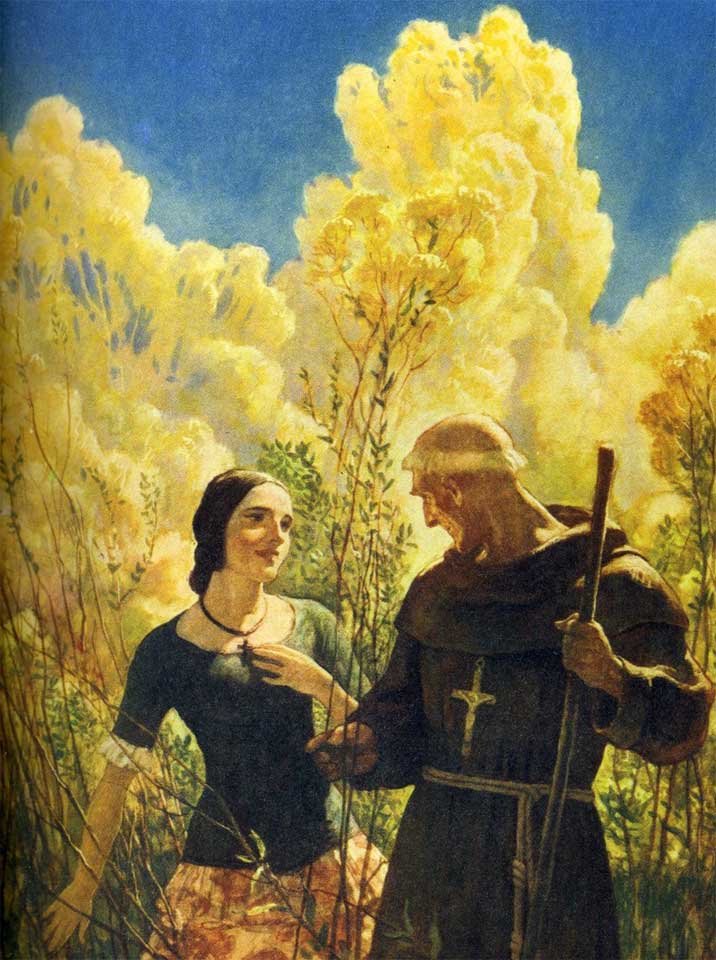
Father Salvierderra is important as a kind fatherly figure to Ramona and the rest at the ranch, but also as the religious authority. He is about eighty in the story, and he travels by foot to the rancho from the mission in Santa Barbara. At the rancho he has his own room where he stays and performs his priestly duties. He is held in high regard by all the characters in the story. From the book, when Ramona first sees him coming to the rancho:

"Ay, Ramona, I am tired," he replied. "Old age is conquering me. It
will not be many times more that I shall see this place."

"Oh, do not say that, Father," cried Ramona; "you can ride, when it
tires you too much to walk. The Senora said, only the other day,
that she wished you would let her give you a horse; that it was not
right for you to take these long journeys on foot. You know we
have hundreds of horses. It is nothing, one horse," she added,
seeing the Father slowly shake his head.

"No;" he said, "it is not that. I could not refuse anything at the
hands of the Senora. But it was the rule of our order to go on foot.
We must deny the flesh. Look at our beloved master in this land,
Father Junipero, when he was past eighty, walking from San Diego
to Monterey, and all the while a running ulcer in one of his legs,
for which most men would have taken to a bed, to be healed. It is a
sinful fashion that is coming in, for monks to take their ease doing
God's work. I can no longer walk swiftly, but I must walk all the
more diligently."


While he eventually leaves the rancho and is no longer an active character in the story, his influence is still felt as various characters refer to him and what they think he would say about their situations.

In the play he gives a few final blessings and leaves. It is the final time we see him in the play. The video gives you an idea of how natural surroundings are used as part of the performance:

Check RamonaEpic Youtube channel.

There are two historic ranchos that many think Helen Hunt Jackson based her story around. When I come back to this in a few weeks I will show you one of them.

Monday, February 14, 2011

Ramona Epic #5: You Are Going to Stay and Help Us?

Happy Valentine's Day! This is the first time we get to see Ramona and Alessandro together.

Check RamonaEpic Youtube channel

In the book, Alessandro's violin was stuck in Temecula. So, he had it brought to him. The distance from Temecula to the rancho will come up in a later blog or two. It is not that important to the story, but it is a minor issue regarding which location is where. It will make sense later.

Sunday, February 06, 2011

The Return to Lago

As I was mentioning on Twitter last week, I can usually tell when certain movies have played on television. Whenever High Plains Drifter comes on this blog constantly gets hit. I think I have seen every search varation of "Where was High Plains Drifter filmed?"

This will be the third time I have discussed this locaton on this blog. I did not mean for it to be like this, but it has turned out to be an important place for a lot readers. I will link everything I have done below in the past here, but unless I find out something new this blog should wrap it up for good.

In fact, the only reason I am doing a new blog on this area is that the conditions were really different. Although I was the guide for this place that day, I had no control over the order of the areas we visited. I would have preferred to come here first with clear morning skies because this just happened to be the same day as what I showed in December. We visited another place to the south, and then we returned here. I was kind of disappointed because I had hoped to have clear blue skies for the video.

Then looking on the "bright" side of things I thought gloomy pictures of where Lago was in High Plains Drifter might actually turn out to be a good thing for the blog. This is looking to the west:
The following is at the beginning of where the town of Lago was in the movie. The set buildings would have been on both sides.
At the end of the town I turned around and looked back. The conditions started to lighten up at this point.
We then visited the lake. A bunch of seagulls were down there and what I call the "viking ship" in the distance.
Back in early December there was a lot of excitement over newly discovered "arsenic based life" here. Like I thought might happen when the hype was over with, a bunch of people examined the research and started poking holes in it. Until some show otherwise, it appears that it maybe back to the drawing board on this one. Or, more appropriate, keep searching.

Since it was important to me to have better conditions for the video I did come back a few days later. I will go ahead and link the video and other related links below:


The Return to Lago (Youtube Version)

High Plains Drifter at Mono Lake (All three blogs on this area, including this one)

Clint Spooks 'Em (Youtube Version)

Clint Spooks 'Em (My blog on the other HPD location nearby)

Regarding what I wrote up on the "alien life discovery" in December.

You can also check any of the labels on the right side that deal with Mono Lake and any other nearby area. I have often pointed out this area from up above elsewhere.

Tuesday, February 01, 2011

Mono Mills

(GPS: N37 53.275 W118 57.650)

Today I am going to cover a quick stop one can make south of Mono Lake on Route 120 on the way to Benton. What this blog should do is make a few connections with what I did in December and a few future blogs I will do this year. This is another one where there is very little left of what once was.

The problem that the town of Bodie and a few of the others had was they were a little too far away from the trees found more to the west on the high mountains. They had to find a way to get lumber for building and for fuel. While there were a few others that brought lumber into these towns, it was Mono Mills that was the answer during their existence.

While driving along the 120 there is a monument just off the road to look at. You can click or right click open in a new window the following pictures to read them if you need to:

At the kiosk that stands over the site they have a bunch of signs:

This is looking down on the what little remains of the mill area. You can barely see a tiny part of the Mono Lake in the background.
So, what they did was build a train track from the mills through the east side of Mono Lake to Bodie. Some more of the debris:
This is from the mills looking west. I just wanted to show that trees that grow here.
The area is a little odd for tree growth. What you see above seems normal for an area like this. If you have seen High Plains Drifter, then you may remember the scene where the outlaws get out of prison. That area is just to the west of here. It has a sandy white dirt look to it, yet some trees grow out there.
In the above picture you can see little tiny trees just starting to grow. I am not going to post the other picture I have, but if I were to turn around to other side of the road you would see a few full grown trees like that.

A Quick Stop at Mono Mills (Youtube Version)

Friday, January 28, 2011

Ramona Epic #4: Felipe is Sick, But...

January has been a month of laying down the foundation for everything on this blog for this year. I have to do one more of these, and from here on out I think things will be a little easier going and not as word intense as the last couple this month have been. I will start with the play story and then talk about the play below.

Our story starts at the Rancho during a time the local Indians have come to help with the sheep-shearing. Senora Morena talks about the condition of her son Felipe at the Rancho. She meets with Father Salvierderra and some of her concerns come out.


The play was started in Hemet in 1923. It is the longest running play in the United States and the official state play of California. Only two years were taken off due to the Depression (1933) and World War 2 (1942). It runs outdoors in a bowl on a hillside. One can see the play on the weekends at the end of April and early in May.

It is privately funded. The only paid roles are the two lead roles of Ramona and Alessandro. The rest of the cast is made up of locals around the area of Hemet. Some famous people have began their careers with this play. For example, actor Victor Jory and actress Rachael (Tejada) Welch.

I set up the RamonaEpic account on youtube for all my Ramona videos. 

You will only see short clips of the play. Some very short and some a little longer than others, but not the entire play. Just enough to let you know what it is like, and hopefully inspire you to see it if you are every in Southern California at the end of April or beginning of May. Of course, I will be showing pictures too along the way.

At this point I am going to transition into something else for the next few weeks and then I will come back to Ramona sometime this next month. This is probably how the rest of the year will go where I spend time on Ramona every few weeks, then do something else on the blog, and then go back to Ramona.

Wednesday, January 26, 2011

Ramona Epic #3: San Gabriel Mission

(GPS: N34 05.820 W118 06.375)

In this blog entry, I am going to try to kill three or four birds with one stone. Originally, this blog was supposed to be connected to the last one. After thinking things through on this I decided I had better split them up or I would make both the blog and video too long. So, this will be another of the foundational background blog entries.

A year ago, this was the first mission of the four I had gone to for this blog. I have covered two already and will link them below if you have not seen them. When I went to this one I took many pictures and took lots of video. At that time I had not done any Ramona stuff yet, nor had I gone to the other missions. I had this idea I was going to be really detailed in covering this one.

That was then, and this is now. I am a bit "missioned" out right now. While not every mission has the exact same structure, I am kind of to the point I feel I do not want to waste as much bandwidth on this one. This is not a cheap shot toward the San Gabriel Mission. It is an important one and I would give it pretty good marks as a museum. I am just going to hit a few highlights and let it go at that.

This will be the only mission I will cover as a connection to the Ramona series. There are a bunch mentioned in the book, including the San Luis Rey Mission which I covered back in Oct./Nov., but this is really the only one that tourists visited as a connection to the Ramona birth place.

The missions are important part of the background to the Ramona book, because the Indians in it are Mission Indians. Let's cover some of the basic history to the missions:

Spain owned California from 1769 to 1821. A series of missions were created during this time period as religious and military outposts. The goal was to convert and colonize the local Indians into the Spanish way of life. In theory, the missions belonged to the Indians and after a time the governing process was to be turned over to the Indians, but that never happened. Spain's reign ended in 1821 as Mexico gained its independence.

Mexico then owned land from 1821-1848. Originally, the missions and land were going to be kept the way it was, but a few years later the secularization of the missions began. Basically, the land was confiscated and given to private individuals. The priests could keep the church, the quarters, and priest's garden. The private individuals that received the land grants could hire out the Indians to work the land. This is what happens in the beginning of Ramona. Finally, after the U.S. war against Mexico, the land became part of the U.S. in 1848 as it is until now.

The mission that would become the San Gabriel Mission was founded in 1771, but due to a flash flood that wiped out the crops it was relocated five miles north to this location in 1776.

This is what the entrance to the church looks like. I did not go in because they did have a wedding going on. For our purposes, like I mentioned in the last blog, this is where Ramona's dad was married in the story.
Here are the mission bells next to the church on the side of the mission. I should note here, that according to some, Ramona's dad was based on the local resident Hugo Reid of Scottish descent. He, like Helen Hunt Jackon, criticized the treatment of Indians in the mission system.
Upon entering this mission it is like a square, but the way it works out is it is like walking around a big U turn. The video covers the highlights better, but let me show a few things here. After seeing the nice fountain they have one enters the cemetery next to the church.
This is the oldest cemetery in Los Angeles. The crucifix is dedicated to the 6,000 Tongva Indians that were buried here.
In the video I show a plaque that is partly dedicated to Padre Garces. He did not die here, but did come here through the San Bernadino Mountains. Also, Mountain Man, Jedediah Smith came to this mission through that trail. After struggling through the Mojave Desert Jedediah came here with his men to rest and recover, but the concern was that they were U.S. spies. So, Jedediah was sent to San Diego to be checked up on. He was eventually told he must leave California so he took his men north and crossed back somewhere in the northern part of the Eastern Sierra. He did spend some time at this mission resting and getting healthy. I will link to the marker for Garces and Smith that I hiked to below.
The above picture is near the mission museum near the back of the mission. The big wooden doors are supposed to be the original doors to the mission. Below is a statue of Father Junipero Serra who founded the mission system. There is usually something dedicated to him at each mission. This museum has some of his original writings. At this point of the mission one crosses over and visits the other features of the mission.
At this point I am going to stop and let the video show what is over on the other side. The one thing in the museum I thought I would show is it has a picture with Ramona tourists in the 1880's. If this is the case then it means that tourists were flocking to the sites right after the book came out.
It is important to note that while Ramona was written as historical fiction, in the end, it was a propaganda piece. There are some things that she glosses over and left out from a historical perspective that would have undermined, to some degree, what she set out to do. I probably will not talk too much about this as we go on, but there is at least one site that I will go over along the way that the violence used in the novel is not related to the violence the site is remembered for.

Ramona Epic #3: San Gabriel Mission (Youtube Version)

San Gabriel Mission (Official Site)

Garces-Jedidah Smith Monument

San Diego Mission

San Luis Rey Mission

Hugo Reid (Wikipedia Article)

Saturday, January 22, 2011

Ramona Epic #2: Ramona's Birth Place

(GPS: N34 05. 860 W118 06.510)

Ramona's family origin is very clearly told to the reader in chapter 3 of the book. However, Ramona does not know her true origin at this point of the story. Here is the little section relevant to what I am going to show today:

"Finally Angus disappeared, and after a time the news came up
from Los Angeles that he was there, had gone out to the San
Gabriel Mission, and was living with the Indians. Some years later
came the still more surprising news that he had married a squaw,--
a squaw with several Indian children, -- had been legally married
by the priest in the San Gabriel Mission Church."


That is what the book states about where Ramona's father was and where he had married. A little later it mentions that an Indian messenger came from San Gabriel to bring news about Ramona's father when Ramona was just less than a year old. So, from this it was inferred that Ramona was born in San Gabriel and lived there for the first few months of her life.

San Gabriel was the first place I went to about a year ago when I came up with the idea I would do this. The book does not give very much about Ramona's actual "fictional" birthplace. This is one of those areas that was created for the tourists. Today, one can still see a few traces of the Ramona influence on the area. In the following picture, I was just outside the San Gabriel Mission looking at the traffic light. I actually used Ramona St. on the way out and drove it as far as I could back to the freeway. For our purposes, I headed to the right to get to the birth place.
The adobe building that was created for Ramona's birth place no longer exists. This is what is said to be that house according to the postcard. One could go here and purchase gifts.
Now another postcard has this.
While I am not entirely sure where the original adobe building was my guess is was very close to the left side of the postcard. I can show where the Grapevine building was and still is today:
The grapevine is said to have been planted in the early 1860's. Apparently, it covered around 10,000 square feet. I did not look inside since the gate to the Grapevine building was closed, but part of that grapevine is said to still be inside it. Today, the building structure to the left is connected to the recreation department. Another postcard has a different angle of the Grapevine structure.
In each postcard you can see something in the background that is overarching the Grapevine. That is the Mission Playhouse that still stands today:
It was used for the play that told the story of the California Missions and the people connected with them. A cast of 150 people with a 4 1/2 hour production. Today it is still used by musicians and fine art performance groups.

While many tourists did come here to see where Ramona was born. This site was never considered as important as some of the other sites I will be showing this year. In DeLyser's Ramona Memories book she only dedicates three pages to this where most of the others have about ten to twenty pages. Still, like I said above, you can see some traces of Ramona around. In the video I point out one more nearby.

Sunday, January 16, 2011

Ramona Epic #1: Introduction

The time has finally come to start this. About a year ago I started to feel I was in a rut and needed something new. I went back and looked into something I had considered doing before. Some years ago I thought about it, but it just did not seem like something I could get enthused about doing. However, last year as I started looking more into the Ramona story I started to see that it was a lot closer to what I like to do on here than I originally thought.

Helen Hunt Jackson (October 18, 2010-August 12, 1885) was very much concerned about the plight of the American Indian. She wrote a book called A Century of Dishonor detailing the problems of government policies or lack of them toward the American Indians. She was disappointed that the book did not really do much in changing U.S. government policy. So, she set out to convince the public by writing a historic fiction novel about the problems.

In order to write her novel she did research on the Mission Indians by visiting California. In doing so she visited many sites of Old California. I will mention a little more about the historical background of the novel in the next blog, but for now the novel takes place during the Mexican to American transition of California in the 1850's. What she ended up doing was describing some of the locations in her novel.

While Ramona was a successful book it would not be for the reasons Ms. Jackson had hoped for. The general public loved the book not for the plight of the Mission Indians, but because of the love story and nostalgia of Old California. So, in some ways, Ms. Jackson's intent backfired because they saw the "historical" basis of the book as something that existed in the past and no longer connected to them. The response was not, "What can we do to help the Indians?" The response was more like, "Wow, California is such an interesting place! Let's go there!" With the advent of the railroad, and eventually cars, the public was able to visit the sites described in the book.

What you are going to see this year is I visited a bunch of sites that Ms. Jackson probably visited when she described them in Ramona. On the other hand, there are areas she may not have been, but were used as Ramona sites in order to satsify the tourist demand. I will mention these when they come up. For inspiration I used Dydia DeLyser's Ramona Memories which I highly recommend for the main Ramona sites. You will see I have added some of my own locations as well. Some very serious, but others not so just to show you the impact of Ramona on southern California.

Along with showing some of the Ramona sites I will be showing some of the Ramona Play that runs in Hemet, CA each year at the end of April and earlier May. I will not be showing the whole play, but just parts that give you an idea how the play is.

If you want to, I would suggest that to make the most out of this you could read the book along with what I will be putting up on here every few weeks or so. It is very easy to find. You can either purchase it, find it in the local library, or download it online. I will be going about doing this in chronological order so you should be able to compare what is in the book with what is a shown on here. The only thing I ask is not to spoil what happens in the comment section. I suspect this will not happen, but this may be the first time someone learns about this story so keep this in mind.

Part of the reason I am doing this is to help educate people on the historical sites and play. Nothing I do with pictures or video really captures that first person experience of visiting the sites or seeing the play. I really hope that if you are ever in southern California that you will visit and help support these places and the play. We live in a time where a whole new generation has no clue about any of this. If I can get even a few people interested then I think I have done my job. It will be an interesting year for me because just about everything I have covered in this blog I have had a history with in someway going back to when I was a kid. With this Ramona series I think I have a good grasp of what needs to be done, but I will still be learning as I go.

What I found fascinating about this story is much of the public actually thought they were reading about real people and real history in Ramona. The fact is Ramona and the rest of the characters did not exist. I will need to quality that as I go along because Ms. Jackson may have used a few persons as inspiration for her characters. It does create an odd paradox that one might actually think Ramona and the other characters really lived and visited these places. The real history and fictional history get mixed up at times along the way.

In the following video I give a short type of lecture of the above and show just the very beginning of the play where the cast enters for the first time:

Ramona Epic #1: Introduction (Youtube Version)

I will be switching back and forth between Ramona and what I normally do on here. So, it will not be just Ramona all this year. You will know because it will say Ramona Epic # in the title. Expect something every few weeks or so all through 2011.

The Ramona Book (Download From Google Books)

The Ramona Book (Text Version)

Okay, with that all out of the way the next blog will show you where Ramona was fictionally born.

Tuesday, January 11, 2011

Stock Footage

I love days like this: 1/11/11.

I just noticed that the past few blogs I have created "walls of text" so I thought I would throw up some pictures before I get into one more "wall of text" in the next blog. This was related to a video I intended to have up around Christmas, but decided to postpone that one until a later time.

One of the things I wanted to mention last time, but cut out, is how I like to integrate and make connection between things. Once in a while I will get a message that says something like this, "The hikes are alright, but I love the movie locations." That is certainly fine, and I can't change personal preferences. There is a sort of "look and leave" mentality with blogs anyways where people look for what they are after and then leave. However, it does show a one dimensional view of how I go about doing things.

What I usually do in my blog entires is show the connections between the locations, the history, the movies, natural history, etc. I like to cross over into different ideas and areas. So, when I have climbed Mt. Whitney or Mt. Langely that is very much related to the movie locations of the Alabama Hills. In fact, I always like to show what the Alabama Hills look like from what up there. Those mountains always show up in movies.

It is the same way with the history and any other subject. This is why I love the backcountry because it is the closest that a 21st century person can get to the days of the old west, mountain men, and anyone else exploring the frontier in the past. Let me give you another example of something I noticed this last year.

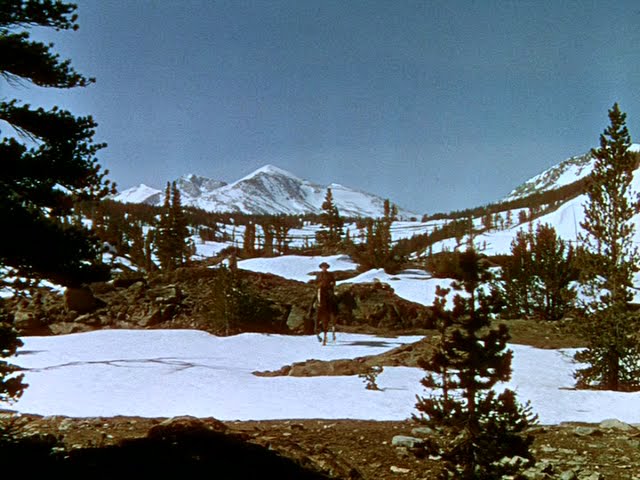
There is a Alan Ladd movie called Whispering Smith that was made in 1948. I have not watched the whole movie yet, but I did see the opening credits. I know most of the rest of the movie was filmed on a town set so I know this was the main outdoor footage that must be stock footage. It is supposed to be Alan Ladd's character, but I think a double filmed this.
Unfortunately, I do not have exactly the same shots here, but it is obvious that the above picture from the movie was looking toward the west near the eastern entrance of Yosemite. I thought I had something better, but the above mountain peaks were taken from my Mt. Dana hike from over two years ago. Those mountains are the same, but I was much higher up. The above picture from the movie was taken from nearby Tioga Lake.The picture below from the movie was taken from nearby Tioga Lake. You can see the big rock formation or buttress that is part of Mt. Dana in the background. If you hike Dana getting past that marks about 1/3 of the way up.
This next picture was taken from the road on the way to Tioga Lake back in November. You can see the same big rock buttress.
This was taken on the trail to Bennettville. The summit of Mt. Dana can barely be seen much further in the background.
Then the footage in the movie shows the area near Saddlebag Lake. What you are seeing here is the mountain range near Mt. Conness. They are near the stream that comes out of there.
My picture from November. Like all of these pictures, the angle is not right, but you can see the obvious feature to the the right. The main mountain in the center of the picture.
Finally, they show more into the direction of Saddlebag Lake. Tioga Peak is off to the right. The mountain you barely see way in the background is near Mt. Excelsior.
There is another movie called Chuka that was made in 1967. I do not have it, but I am pretty sure it uses this exact same footage at the beginning of the movie. It may be used in other movies as well. I truly wish they really had made a full movie back here. Maybe there is, but I do not know if any at this time.

Now my hikes back here really do not need any connection to movie history, but I thought I would show you there still is a connection. This blog will relate to what I will show in the next one.

Saturday, January 08, 2011

The Beginning of An End

I have thought a lot over this during the past year. I have decided this will be the last full year of putting as much effort into this blog as I have. So, by the end of this year the blog will come to an end.

I originally started this blog as a way to send family and friends the latest things I had been up to. It was easier to just send a link to here rather than send separate e-mails at different times of the year to separate people. Over time I have had lots of others follow along on what I have been doing. 

While I have not shown every single part of every area I am getting to the point where I have covered a lot of my favorite places to show. That is not to say I do not know of any other trails or places to go. It is not like that at all. There is always something out there to discover. That is one of the goals I hope has come across during my time in doing this. That wherever you are there is always something you can find "out there." 

For me though, the end result has to be something of interest to me in order for me to post about it. Simple walks through a forest or movie locations where there is absolutely nothing left are not worth posting. There have been somethings I have done that I have never posted for this reason. 

One has to have a certain amount of drive and motivation to do this every week. I do enjoy it, but there are other factors where "life gets in the way." The economy is always a factor. As much as I penny pinch, cut back, and make the necessary sacrifices to continue to do what I do on here there is always another fee or a new tax around the corner. That's life, but my drive to do this just has not been the way it used to be because of it. 

Notice that I did not say the blog will come to THE END. All I am saying is that this will probably be the last year where I put something up every week or two. I suspect I will continue, but a lot less frequent than before. There are somethings I want to do that are a lot further away than my normal range. Those take time and money, but I think things might turn around this year, or the next, and I might start doing that. 

This year I will be spending a lot of time developing my Ramona series. That is something that I suspect will take some getting use to as I go along. In the next blog or two I will be starting that. It will take me about 40 or more blog entries to present all of it. It will not be the only thing I do here because I will continue to show more of what I normally do. I will be moving back and forth throughout the year. I have a few more ghost towns to show. I will finally get to show my favorite one even if there is really nothing left of it. There will be a few movie locations here and there. I have held back on a some for a few reasons. There is so much I need to do in the Alabama Hills, but sometimes the weather conditions are not the best so I postpone what I have. It is easier to wait and go back. Those are easy to do so I do not feel I have to just post anything I have.

 A couple of things I want to mention are things I have mentioned before, but I thought I would do it again:  

1)Understand that many of the topics I post on here I do in order to stimulate interest in a subject. I do not always explain every detail I know on any given blog entry. 

My goal is to create interest and give a source or two. The rest is up to you if you want to pursue some topic or visit some area. I am not doing graduate level paper writing here where I feel I have to document every single word I write. I am really "old school" about this in that I think proper research really should be done by reading books and not consulting websites, blogs, or search engines. So, please understand that if I link to Wikipedia I am not saying that is the best source of information. I have linked to Wikipedia in the past knowing some of the details of what is said I may not agree with, or I know may be wrong, but it is a good start in trying to pursue more information. Sometimes I give sources that are dated, but are popular or easy to get. 

A few years ago I purchased a real scholarly tome on an old west vendetta that I have a real interest in. It was cutting edge with all sorts of new information in it. A great book! However, it is not the book I would recommend to just anyone. Keeping track of who's who and all the details in that book would be very overwhelming for some people. That is why I would probably recommend an older dated classic treatment of the history rather than that book. One can then decide if he or she wants to "graduate" to the scholarly tome. It saves some frustration that way. Also, a lot of "old west" history is "grassroots" or "folk" history in that there is a lot hearsay and stories repeated that are difficult to verify. Just because something is in a old newspaper doesn't necessarily mean the people and events are verified, but it does help. So, sometimes I just give a quick popular summary of some of the stories I have read knowing some of the sources might have some problems. Sometimes I read stuff that people think they are doing history when they aren't. If you were to ask these people what is their criteria is for an inference to the best explanation you are probably not going to get much of an answer. It's the nature of the beast. Keep this in mind when I give out sources for anything from history to science.

 2)My time is limited on here due to work and have other issues in life I must attend to. I do not always have my computer on all the time. So, if you send e-mail give me a few days to respond. I do get lots of real e-mail, so it takes me some time to catch up and respond.  

Keep in mind I am not actively looking for comments on my blog entries on here. If you comment on things that are back in the archives, and really want my attention, you probably will not get it since I will not see it for quite some time. I might see it eventually, but you might be waiting for many months for a response. Also, I tend not to respond to every comment. Again, e-mail gets the job done better. 

 3)I very rarely advertise myself online. 

I have people that tell me they will link to me quite often and then proceed to tell me that I will get lots of traffic. There is no problem with this and always feel free to link to whatever I do. I get hard working people to some that have definitely made themselves famous in the world that come on here and read some of my exploits. However, I am the type that likes the idea that people have to work a little harder to find what I do rather than have it spoon fed to them. You could probably guess that it would make sense that I always enjoy things when I search hard to find them rather than being told where to go. The reward is greater this way. Years ago when I was heavily into rare Japanese movies that were difficult to get in the U.S. I enjoyed the research and the search to find what I was after. Some people I knew liked this too, but then we started to encounter people that just wanted to be spoon fed a few links and did not appreciate the amount of work that needed to be done to get what we were after. As it is, it is not difficult to find what I do on few google searches. The people that want to find what I talk about will find it. If I am not on every search engine or some important website It is not something that concerns me. 

4)Finally, there is some danger involved in a lot of stuff I do. 

I usually plan out a lot of stuff you see on here at least a year in advance. In most blog entries I put up some approximate GPS coordinates. Keep in mind you have to know yourself in this regard as far as what your limitations are. At times I tend to go off by myself, but for others that may not be a good idea to travel alone. 

I hardly mention this on this blog, but usually about 3-4 times a year I will see that someone has died at or had to be rescued from some area I mention on here. Just this last summer I was up hiking right near a tragedy had happened a month earlier. This is not just hiking either, some of the areas one must drive to can have problems too. If you are not careful you could get into accidents or stuck out in the middle of nowhere with no cell phone reception. So, keep all of this in mind if you take off into the back country wherever you go. 

Alright, I have said a lot here, but the bottom line is that I just do this for fun. I have been using computers "online" since the pre-internet days of Bulletin Board Systems. There are many uses of the internet that I think are trying to turn it into something that is was not meant to be for. But, throwing out all the high tech nonsense, I see what I am doing here like inviting someone into my home and sharing some pictures and stories. With all that out of the way 2011 will be a fun year. Wait and see...