Tuesday, August 16, 2011

Ramona Epic #21: La Casa de Estudillo (Part 1)

(GPS: N32 45.265 W117 11.810)
(AKA The Marriage Place of Ramona and Alessandro)

"Alessandro had explained to her his plan, which
was to go by way of Temecula to San Diego, to be married there
by Father Gaspara, the priest of that parish, and then go to the
village or pueblo of San Pasquale, about fifteen miles northwest of
San Diego."

In chapter 18 of Ramona, as Alessandro and Ramona are traveling, there is a lot of talk about the California Missions. The talk of it is not always good about the priests and some of the Indians that inhabited them. One of the persons spoken of is Father Gaspara, one of the good ones, in San Diego. That is where they go after Temecula in order to be married.

This will be the first of three blogs on this site in Old Town San Diego. The Estudillo home (La Casa de Estudillo) became known as the marriage place of Ramona. I will cover some of the real history in the next blog, but for this one will focus on the fictional history involved.

In the Ramona book, Helen Hunt Jackson has her main characters go to San Diego to be married. There are a few brief descriptions of the place where they were married, but nothing to the extent of some of the other places mentioned in the book. However, this site had been a major Ramona tourist destination from the late 1880's as pointed out in the chapter dedicated to it in Dydia Delyser's Ramona Memories book.

From the very beginning, the site became a major point for Ramona merchandising. All sorts of trinkets could be found to be sold here. These days you probably will not find Ramona goods at this place, but if you go on e-bay you still might find old postcards like the following:
From somewhere very close I got this:
Another postcard one can find shows the entrance from the other side.The little bell tower you see was added later.The entrance. The adobe originally started out as L-shaped, but then was developed into a U-shape as many of these old adobe homes tend to be..So, this is one of those places that, although had a history of its own, was developed into a Ramona tourist site for the public as a money making venture. No one knows if Helen Hunt Jackson visited this place, and there really is nothing in the book to indicate that this was where Ramona and Alessandro were married.

With that said, it was not a total stretch for one to come to the conclusion from reading the book that this was close to where the event took place. I will mention a few items in the next two blogs about this.

Ramona Epic #21: The Marriage Place of Ramona (Youtube Version)

Monday, August 15, 2011

Hoppy Rocks! (The Alabama Hills Series)

(GPS: N36 36.260 W118 07.060)

Here is one that I should have had taken care of when I began the blog. In fact, for quite some time I thought I had already had something about it, but one day I was going back over some of the early blog entries and realized I never did. Then over the past few years I just delayed doing it because I always wanted to get better video footage of it than what I originally had. So without further ado, let's talk about the Hoppy Rocks.

In the Hopalong Cassidy movie Silent Conflict, Hoppy and California are being chased through Lone Ranger Canyon. They hide behind some rocks as the men who are chasing them go by.Lots of b-movies used this area for horse chases. It would be too difficult to mention them all.As the men chasing them go by, Hoppy and California are hiding behind two big rocks in what is known today as the Hoppy Rocks.Tim Holt and Gene Autry used them too in their own movies.Now, just take a few steps to the left and rotate toward your right you get this...which was used in a gunfight in Hoppy's Secret of the Wasteland.A lot of these old b-westerns just filmed in the same areas, but filmed different angles to create a "new location" for each movie. All it takes is a few steps, or a slight change of camera angle, to do this. Hoppy actually used this trick of having someone chase him and then hiding behind a rock in Lone Ranger Canyon many times. It was not always at these rocks.

Silent Conflict (Youtube Version)

Friday, August 12, 2011

The Gun Smugglers Rock (The Alabama Hills Series)

Here is one that is in Lone Ranger Canyon on the way to Gene Autry Rock, but is very easy to miss. If you are where the Lone Ranger Ambush scene was then you just go a little further east on the road and just off trail to your left.

There is a rock that is cutout rather nicely. Actually, there is another rock like this one too nearby, so it is nice to have a picture from the movie to tell which one is which. When I originally looked for this one years back, I did not have any pictures with me. I knew the approximate site due to knowing how Lone Ranger Canyon is used in Tim Holt's Gun Smugglers. I ended up taking pictures and old camcorder footage of both spots. I then had to verify it at home.

In this scene the army is ambushed in Lone Ranger Canyon. Martha Hyer pulls the Sergeant into the cutout rock.Here is that rock. Notice the little hole in the rock?
Martha Hyer then defends herself behind the rock. Tim Holt and Chito eventually show up to help out.Here is a different look from some years back. The clouds were covering the mountains that day making it overcast.The L.P. Film Festival has a sign out for this one in October. It is one you could easily walk past, but during that weekend you can't miss it if you look for the signs. Edit note: I am told this has changed in the past few years. Since I have not been to one of the recent festivals I do not know how they do this now, but from the recent comment I received they do not have the signs out at the sites anymore. :(

Saturday, August 06, 2011

Ramona Epic #20: The King of Temecula

(GPS: N 33° 27.845 W 117° 07.200)

In finishing up my short series in the town of Temecula I thought I would connect the last blog about the store to this one. The last place I visited was the store of Louis Wolf. Louis Wolf was a European immigrant who arrived in Temecula in 1857. Since he not only developed the store I mentioned in the last blog, but helped develop and influence the early town of Temecula in such a way that he was known as the King of Temecula.

One thing he had done was to have his gravesite overlooking the town of Temecula. So, off I went driving through a residential area of Temecula. Through twisting and turning streets, I finally found the Cul-de-sac it is on. The gravesite is literally right next to some homes behind a locked gate.
There is a small plaque that shows a picture of him, names, dates, and the people that helped contribute to the restoration of the site. From around 2002-2007, the site was restored since the sarcophagus had been sicking into the ground and was damaged.At this point I was getting used to taking pictures over fences and gates. It was good enough for what I wanted to do anyways.I zoomed in on the sarcophagus.
In Helen Hunt Jackson's book, Ramona, the character who owns the store and is the main business man of the community in Temecula is Mr. Hartsel. So, the connection between Louis Wolf and Mr. Hartsel is a simple logical one. On the other hand, Mrs. Hartsel is the one that communicates with Alessandro while he was there. The Mrs. Hartsel connection would have been Wolf's wife, Ramona Place Wolf.

It is often said that Ramona Place, who was part Indian, was an influence on the main character of the book. It has been reported that Helen Hunt Jackson interviewed her about the Indian situation in Temecula. I am sure there were a variety of influences on the Ramona character, and this will come up again later near the end of this series.

As an aside, Ramona Place Wolf was supposedly buried at the San Luis Rey Mission cemetery, and not with her husband.


Some of the links I provided in the last blog are connected to this one, but I will add a few more:


When I get back to this series I will show the next stop Ramona and Alessandro made..."where they were married."

Wednesday, August 03, 2011

Ramona Epic #19: The Wolf Store

(GPS: N33 28.750 W117 05.995)

"Hartsel's was one of those mongrel establishments to be seen
nowhere except in Southern California. Half shop, half farm, half
tavern, it gathered up to itself all the threads of the life of the
whole region. Indians, ranchmen, travellers of all sorts, traded at
Hartsel's, drank at Hartsel's, slept at Hartsel's. It was the only place
of its kind within a radius of twenty miles; and it was the least bad
place of its kind within a much wider radius."


While Ramona is at the cemetery, Alessandro is trying to sell his violin at the Hartsel store. Alessandro had lived nearby and does sneak by his home that is now occupied by new residents. He gets to the store and talks to Mrs. Hartsel since Mr. Hartsel cannot speak with him. She ends up loaning him some money and tells Alessandro to come back the next day to sell his violin.

The only store that fits the description and would have been the place in old Temecula for commerce like this is the Wolf Store. This store is still around, but is currently fenced off along with a bunch of other buildings in the area. The area is currently listed as being in the process of being restored. All I could do with look over a fence to view the buildings. The Wolf Store is the one on the right.

Louis Wolf had his store built sometime in the 1860's and was the main place for commerce in Temecula until 1905. The following picture was taken around 1890.This is what it looks like today. It is the oldest building in Temecula that is still around.One thing I was puzzled by was the landmark sign on the building. That is what a California historical landmark (CHL) would look like. On zooming in I saw that it said, "Treaty of Temecula." I was puzzled by this since I did not know of any CHL around here. From what I remembered from reading, the treaty was not signed at this store, but across the way in a place no longer around. I'll come back to this down below.I do not know anything more about the other structures in the area. Whether they go back as far as the Wolf Store I do not know.At some point in the future, this area is supposed to open up to the general public. I hope they can get the resources to get this done.This is another area that the modern shopping stores have built around. Although enough area has been separated to make this look like part of the old world.

The Wolf Store (Youtube Version)

A few links you can check out:

The Wolf Store (and restoration) mentioned on the Vail Ranch site

The Wolf Store (Wikimapia): this shows you where it is at

Louis Wolf and His Store

When I got home I did a few searches on that Treaty of Temecula plaque I saw. The only thing I could find was an old Desert Magazine (January, 1966) article that shows it.
Like I said earlier, from what I have read, this treaty was not signed at the Wolf Store, but some other nearby place. It was a treaty signed by a few of the local tribes, but rejected by the U.S. Senate. I am sure you can search "Treaty of Temecula" to find out more of the history on this one.

Tuesday, August 02, 2011

Ramona Epic #18: The Old Cemetery

"His silence was more than silent; it was taciturn. Yet she always felt herself
answered. A monosyllable of Alessandro's, nay, a look, told what
other men took long sentences to say, and said less eloquently.

After long thinking over this, she exclaimed, 'You speak as the
trees speak, and like the rock yonder, and the flowers, without
saying anything!'

This delighted Alessandro's very heart. 'And you, Majella,' he
exclaimed; "when you say that, you speak in the language of our
people; you are as we are.'"

In chapter 17 of the story Alessandro takes Ramona with him to Temecula so he can sell his violin in order for them to have some money so they can be married. There is some concern that they could be caught by those sent from the rancho to find them. So, Ramona agrees to stay at the cemetery while Alessandro attempts to find out what is going on in Temecula and sell his violin. There she meets Carmena who is grieving over the loss of her husband. Carmena does not speak, but she is glad Ramona is there and they hold hands.

Visiting this particular cemetery is somewhat disappointing. I knew this would be the case even before going to it. There is really nothing there these days. In fact, unless someone told you, you would probably have no clue it was a cemetery.

The modern world has been completely built around it. A shopping center with many modern chain stores has taken over. What separates it from the modern world is a big wall around it.Looking over the wall is a big square flat dirt field. How many times have I seen something like this elsewhere and not thought anything about it? However, in this case, it was a historical cemetery.The real historical basis for this cemetery took place during the Mexican War. While a few battles were taking place in California, the Battle of San Pasqual near Escondito was won by the Californios (the Mexican side) around December 6, 1846. After the battle 11 Californios went to an adobe in Pauma Valley. There a bunch of Luiseno killed them in what is known as the Pauma Massacre. It was said that they were tortured and killed in a way to brutal to describe.

No one knows really why this group of Indians did this. There is some thought that the recent Battle of San Pasqual had something to do with this and thinking of the Americans as their friends. Or, some of their horses has been stolen by the Californios. In any case, they were avenging something.

Jose Del Carmen Lugo was ordered to avenge the massacre. In December, 1846 (and January, 1847) he took the men he could get and got the help of Juan Antonio, leader of the Cahuilla Indians, with his men. With a combined force of Californios and Cahuilla Indians, Lugo led them to the mouth of a Canyon near Vail Lake. As an aside, when I was younger I often fished at Vail Lake.

There they hid, setting up the ambush, and sent some of their men into the canyon. A few of he men went into the canyon to trick the Luisenos they were after to chase after them. The trick worked, and as they came out the Temecula Massacre was on.

No one knows how many Luisenos were killed. Estimates are between 40-120. The dead were gathered and buried at this spot in Temecula. This is the origin of the cemetery.

A couple of my own thoughts on this:

One thing that is hard to describe in a quick historical summary like this is overgeneralizing a group of people. Sometimes we talk about the Californios, the Americans, the Indians, etc. as if they were unified group of people. When reading Horace Parker's small book (listed below) I kept trying to figure out why some of the Californios were not really following orders of the Mexican side, why groups of Indians were attacking each other, etc. In the case of the Californios they were on the Mexican side of the war, but did not think of themselves as Mexicans. So, their immediate concerns came first over whatever General was ordering them to do. In the case of the Cahuilla Indians going against the Temecula/Luiseno Indians, that appears to be retaliation for a battle lost by the Cahuilla Indians years earlier that had nothing to do with any sides of the Mexican War.

So, the historical reality of the cemetery has nothing to do with Helen Hunt Jackson's version of why it was there in the fictional Ramona book. In fact, had she actually mentioned the historical reality behind the cemetery it would have undermined the premise behind her book. War and politics are usually really messy when comes to this.

The Old Cemetery (Youtube Version)

The following links are old pictures off the USC Digital Library of the cemetery:

An old picture of the cemetery

Another old picture of a grave in the cemetery

For my quick summary of the events involved, I used the following book which I found at a local library:

Parker, Horace. The Historic Valley of Temecula: The Temecula Massacre. Balboa Island: Paisano Press, 1971.

The following links should be helpful:

Temecula Massacre (Old Town Temecula article)

Temecula Massacre (Wikimapia): this shows you where it is at

Temecula Massacre (Wikipedia article)

Whizzing Past the Graveyard (North County Times)

A Look Back: The Temecula Massacre (Press-Enterprise)

Saturday, July 30, 2011

Ramona Epic #17: Ramona Tire

As I spend the next few blogs in Temecula for this series I thought I would lighten things up by showing you how the Ramona name is even used as the name of a tire company. This is the one in Temecula, but they are all over the Inland Empire. Of course, as one might expect, the headquarters is in Hemet.
Ramona Epic #17: Ramona Tire (Youtube Version)

Wednesday, July 27, 2011

Leavitt Falls

(GPS: N38° 19.345 W119° 33.685)

Here is one I was not sure I was going to post on here when I did it a year ago. I was at the same spot over a month ago, and I decided to post this composite.


Leavitt Falls is on the way to Sonora Pass via HWY 108. I usually come by this area once every few years, but we were interested in the water levels this year due to snowmelt at the time. The left side picture is from August, 2010, and the right side is from mid-June 2011. It just gives you an idea of how the water was in June of this year. There is a lot of water in the streams and lakes this year which is good.
 

Wednesday, July 13, 2011

Ramona Epic #16: Tragedy and Escape

Here we have our big transition in the story. After Alessandro left and had been gone for many days he comes back to the rancho:

Check RamonEpic Youtube for video of this.

In the 13th chapter of the book, before the above scene takes place, there is very little dialogue with most of the characters trying to outthink and out-scheme each other. In my notes I referred to this chapter as the "silent chapter". Ms. Jackson writes this about Senora Moreno:

"There is nothing so skilful(sic) in its own defence as imperious pride. It
has an ingenious system of its own, of reprisals, -- a system so
ingenious that the defeat must be sore indeed, after which it cannot
still find some booty to bring off! And even greater than this
ingenuity at reprisals is its capacity for self-deception. In this
regard, it outdoes vanity a thousandfold. Wounded vanity knows
when it is mortally hurt; and limps off the field, piteous, all
disguises thrown away. But pride carries its banner to the last; and
fast as it is driven from one field unfurls it in another, never
admitting that there is a shade less honor in the second field than
in the first, or in the third than in the second; and so on till death. It
is impossible not to have a certain sort of admiration for this kind
of pride. Cruel, those who have it, are to all who come in their
way; but they are equally cruel to themselves, when pride demands
the sacrifice. Such pride as this has led many a forlorn hope, on the
earth, when all other motives have died out of men's breasts; has
won many a crown, which has not been called by its true name."


Regarding the above scene, there are a couple of crucial differences between what happens in the play and what happens in the book. Alessandro does come back to the rancho at night, and Ramona meets him. He reveals that his family and tribe were forced out of Temecula. The thing about his father being shot is different than the book. In the book he is ill. Alessandro takes him to nearby Pachanga where he dies. He buries his father there. In the play he states the Temecula cemetery had been destroyed, but in the book it is a matter of them not being allowed on the property now that it is owned by the white man.

In the book and the play, Alessandro does give Ramona her new name, Majel, the wood-dove. Ramona states she thinks it might be better as Majella, and Alessandro agrees. They both agree to leave together.

So, after all this time, this is the point of no return. Ramona leaves Felipe a note, but she has left the rancho for good. She is now going to live her life as the Indian she is with Alessandro.

When I get back to this in a few weeks I have a series of about five locations in row that relate to their trek from the rancho to where they are married.

Sunday, July 10, 2011

Ramona Epic #15: The Family Jewels

In the play, the intermission is right after the fiesta scene they have at the rancho. Then, after a bit of slapstick from some of the minor bit characters while everyone is coming back to their seats, we have the two scenes that create the great turning point of the whole story.

The problem for Senora Moreno at this point is trying to resolve the Ramona/Alessandro situation. The idea is Ramona has brought shame to the rancho with her actions regarding a low class Indian. One of the Senora's thoughts is to send Ramona away to be a nun. The Senora has always seen Ramona as a burden from her sister. This would resolve dealing with Ramona once and for. Although, there is some idea that Felipe might take Ramona as his wife, and that would be more respectful in her eyes.

The Senora does have one other card to play that was provided by her sister before her death. An iron box with jewels, a hankerchief belonging to her father (Angus Phail), and a note from her adopted mother (the Senora's sister: Señora Ortegna). This is somewhat like an inheritance for Ramona, but in order to get it she must marry "worthily" otherwise the inheritance becomes property of the church. This is essentially what the note reveals.
So, the jewels are what the Senora uses to bribe Ramona back into her way of thinking.As was mentioned at the very beginning of the series, the reader is told within the first few chapters that Ramona has Indian origins through her real mother. She is also Irish through her father, although that is not as emphasized in the play as much as in the book. Both the book and the play have a few other characters discuss her origins. Then, it is finally at this point that Ramona learns of her real mother and her Indian heritage.


One thing I should point out is I cut out of the play's scene just a little early in the video. After rejecting the jewels and revealing that she will marry Alessandro no matter what, Ramona runs out, the Senora falls down as if losing consciousness. This is to indicate that her time is coming to an end, and it is also the last we see of her in the play. In the book this part does not happen for this scene.

Check RamonaEpic Youtube channel for video of this.

I mentioned some about Ramona's birthplace early on in the 2nd and 3rd blogs for this series, but I also mention some of her origins in the 9th blog if you want to go back and check those out.

Saturday, July 09, 2011

Ramona Epic #14: Fiesta Continued

Here the fiesta continues and Felipe (from 2011) has a number:

Check RamonEpic Youtube channel

I should note that this marks the intermission point of the play. As far as this series is concerned we have a few more blog entries before we reach the mid-way point. I want to emphasize that the next two videos are crucial for direction of the rest of the series. Check back soon.

Friday, July 08, 2011

July 4th Weekend: The Truck and Walker River

I had started this one with a rant on the lunacy that happens on the July 4th weekend in the Eastern Sierra. I deleted it. Let me give you the quick version: the property owners, that I know of, loathe this holiday period due to the heavy concentration of people, the trash/litter, the inability to drive the roads properly, trespassing, and just rude behavior. It is a relief when it is over, and some recovery has to take place. The following is probably one of those situations that you have to be on guard over anytime of the year, but especially the July 4th weekend.

On the way to Carson City, NV on HWY 395 there is a section of road that really curves back and forth. This truck overturned on the road right next to the Walker River.
The guys working there were still transferring all the goods from the truck three hours later when we went back through there. Meanwhile, the water is really flowing in the Walker River right now. There is lots of water running from the snow melt. Much snow is still in the back country for this time of the year. Because of this, I am not sure how much hiking I will get done this year. There are one or two things I would like to get done, but I have to wait it out right now.

In the meantime, I did get a bunch of movie locations videoed. Most of those are new versions of some areas I have done in the past. That is just a matter of getting the editing done. The next three blogs will get us to about the halfway point of the Ramona series. There are some fun locations still to come for that series; this is why I want to put up the next three in a few days time. At that point, things will be a changing!

Monday, June 27, 2011

The Mt. Wilson Observatory: Albert Michaelson's Interferometer

The last thing I did before I made my descent was to check out the CHARA exhibit hall. Inside it they have the interferometer that physicist Albert Michaelson helped develop. This 20-foot device was placed on top of the 100-inch scope. The mirrors combined to produce a higher resolution. Interferometry is the big word, but for our purposes the goal of this device was to determine the diameter of stars. The room was too small to get a whole picture of it so I had to stitch two pictures together:One example of this that I mentioned in the video was the diameter of the red giant star Betelgeuse. During the winter months you can easily see the constellation Orion in the sky. It is well known and even mentioned in the book of Job (9:9 and 38:31) in the Bible along with the Pleaides which is the group of stars that you can barely see at the very top of this next picture. The following is a screen shot from the Stellerium program that shows Orion. I zoomed into Orion. The constellation is supposed to be the mighty hunter Orion. His "belt" is the three stars in the middle. The tip of his dagger below his belt is where the Orion Nebula is. Betelgeuse is where his right shoulder is.On December 13, 1920, With the use of the interferometer, they were able to determine the diameter of the star. They found out that if you were to place Betelgeuse where our sun is it would engulf all the planets out to Jupiter. So, we are talking at least beyond the orbit of Mars to the orbit of Jupiter. In any case, it is VERY BIG!

After this I went back to the water fountain one more time. Then I started the trek down. In a few hours I made it back to my car and got home safely. The one thing I was a bit concerned about is that I had heard that you can encounter rattlesnakes on this trail. My concern is if one were on the narrow trail I would have a hard time getting around it. It was warm enough on the way down for one to be on the trail. That never happened, but a ton of lizards were running around.

One thing about Mt. Wilson during that day was it was very quiet, and there were few people walking around. Those people probably worked there, and I may have been the only visiter there that day. There are areas marked off that are clearly private and tell you not to go there because the astronomers are sleeping. The one area I had hoped to get to was the speed of light experiment area that Michaelson did his famous test to determine the speed of light. Unfortunately, that is in one of the areas the public is not supposed to go to even though they have a few markers at the spot. I probably could have used my silent skills to get there without causing problems, and I know some have, but out of respect for the history of the observatory I did not do it. It is one thing when museums that take your money will not allow you access to things like this, but since the observatory is free to visit I wanted to be extra respectful about following the rules that have.

Einstein Was Here! (Youtube Version)

Ocean of Clouds at Mt. Wilson (Vimeo: some alternative footage I shot for the ending of my hiking video. It is kind of interesting because they were flying in the parts via helicopter.)

Stellerium (The free program I used for the two pictures above. I highly recommend getting this if you have any interest in the night skies.)

Mt. Wilson Observatory (Official Site)

Again, books and other printed material are the best to read about all these topics, but just as a starting point:

Albert Michaelson (Wikipedia article)

Astronomical Interferometer (Wikipedia article)

Mt. Wilson Observatory Association Booklist

Thursday, June 23, 2011

The Mt. Wilson Observatory: The 100-Inch Telescope

(GPS: N34° 13.545 W118 03.430)

Last time I was crossing the bridge to get to the most famous telescope at the observatory. There are many plaques with signs about each scope around the observatory. There is usually a timeline, pictures of discoveries by the scope, write-ups of the important discoveries, and a "blue print" of the telescope. This is part of the one for the 100-Inch Telescope.From the bridge you just go to your left and around the corner in this following picture. Then there are two open doorways. You can go up either one because it gets you to the visiter room to view the telescope. In the video, I kept walking up the stairs just because I liked the effect of it, but no need to post pictures of them here.This telescope is known as the Hooker telescope because Joseph Hooker was the one who invested the money into making it. What happened in astronomy during the late 19th and 20th centuries is scientists were dependent on very wealthy philanthropists to donate and invest in observatories and their telescopes. Observatory director George Hale had to spend much time lobbying for funds rather than spending all his time doing more scientific research. Hale was always pushing for bigger telescopes. After the 60-inch scope he wanted a 100-inch telescope built. In around 1906, the 100-inch mirror was okayed for production in France. It was finished in 1908 and sent across the Atlantic. When it finally arrived Hale and others examined it with great anticipation. Unfortunately, there were bubbles in the disk and the glass was fused. This was a major let down since they realized they would not be able to use it. After thoughts of getting a new mirror, Hale decided it might work after all. So, he had the mirror grounded and polished in 1910 and finished in 1916. It was finally taken up the dirt road to Mt. Wilson on July 1, 1917. The telescope was ready and first used in November of 1917. However, due to World War I, the scope was not really used until after the war was over.What you see above is the bottom part of the telescope. The 100-inch mirror resides there. It is a reflecting telescope in that it captures the light and reflects it off the mirror for viewing. The picture below is just looking straight up the frame of the scope.
In the following picture, Edwin Hubble is on the left and James Jeans is on the right. There is a chair, known as the Hubble Chair, that can move into place to view the telescope. The scope, the dome, and the chair can move into place to view whatever part of space needs to be viewed.There is the Hubble Chair. You can see how it would movie into position. Essentially, it is the same scope that went up on 1917. I am sure there have been part replacements, etc., but the mirror and what you see is the same.There is where the dome can open up.
As I mentioned last time, the prevailing view was that the only galaxy that existed was our Milky Way Galaxy. What people believed they were seeing through telescopes were only nebulas that existed in our own galaxy. Harlow Shapley was a leading advocate of this point of view.

Edwin Hubble began using the 100-inch telescope in the 1920's. He favored the alternative hypothesis of the time that we are part of an island universe where there are many galaxies beyond our own out there in space. The problem was that during this time there was no way to gage the distances on how far these nebula were away from earth. On October 4, 1923 he was doing his nightly routine of taking pictures of various nebula when he took a picture of the "Andromeda Nebula". Hubble examined the picture later and noticed a new speck of light in the nebula. He indicated it was a nova. Then, while going through old pictures back to 1909 of the same spot he determined he had found a variable star. Not just any variable star, but a Cepheid variable star. This type of star changes its luminosity in a cycle over a period of about a month in such a way that it can be used as a "standard candle" in astronomy. Basically, a common analogy is, if you know you have a 100-watt lightbulb you can measure its brightness to determine how far away it is from you. The further it is away from you the dimmer it will be, but you can measure that based on your knowledge of how bright it would be a few feet from you.

Hubble ended up finding more Cepheid variable stars and had definite evidence that the spiral nebula they were seeing were not nebula after all, but were much further beyond our galaxy. The Andromeda Nebula was really a galaxy itself: the Andromeda Galaxy. So, from this discovery at this telescope we found out that we are just one galaxy among many in the universe.

The second discovery was done years later. By 1929, Hubble, with Milton Humason, had determined the distances to 24 galaxies. They noticed the galaxies were red shifting. By measuring the velocities of the galaxies they found out that the velocity increased the more distant the galaxy was. A galaxy 10 million light years away travels twice as fast as the galaxy 5 million light years away. Basically, the galaxies were moving away from each other at great speeds. This was the evidence that our universe is expanding, and was the foundation for the Big Bang Theory about the beginning of the universe.

I'll cover one more item at Mt. Wilson Observatory next time as I wrap this one up.


Lots of books can be found about the Mt. Wilson Observatory, Edwin Hubble, and this telescope. A good non-technical level book is Marica Bartusiak's The Day We Found the Universe. She gives all the background history needed and emphasizes that it was not just one scientist that made these discoveries, but each scientist laid down the necessary research as the foundation for the major discoveries.

Wednesday, June 22, 2011

The Mt. Wilson Observatory: Einstein Was Here!

Continuing from the last blog about the solar telescope...

I mentioned last time that when the observatory was founded in 1904 until 1919 it was known as the Mt. Wilson Solar Observatory. During that time there were three major solar telescopes here: The Snow Solar Telescope, The 60-Foot Solar Tower, and the 150-Foot one I showed some of last time. The solar was dropped from the observatory name in 1919.

I continued walking for a few minutes and passed by the dome of the 60-inch telescope dome. It is a reflecting telescope with a 60-inch diameter mirror. This telescope was completed in 1908 and was the biggest in the world at the time until replaced by a bigger one at this observatory. It is the only telescope at Mt. Wilson the general public can use for a fee.
In 1916, Harlow Shapley used the scope to determine that the M13 gobular cluster of stars is 36,000 light years from us. This showed that the Milky Way Galaxy we reside in was quite large. At that time, since they were still trying to figure out how to gage distances, it was believed that our galaxy was the only one out there. We'll get to some of the historical debate on this in the next blog. One thing to add on this is that Shapley assumed that M13 was closer to the center of the galaxy, while our sun and the earth were far away from the center. We now know this to be true.
In the above picture, the 60-inch dome is off behind the trees to the right side of the picture. The little building to the left is the "galley" where astronomers could make their meals, drink coffee or tea...more on this in a moment. However, notice that little drinking fountain next to the short stairs! I was so relieved to see that. It was so cold, and I made sure my water bottles were filled up for the hike down. I knew I would be okay going down now. See the little dome in the distance? Notice the pipes running from it to the right side of the picture? Those same pipes are in the picture below. This is just part of the CHARA (Center for High Angular Resolution Astonomy) Array. Spread throughout Mt. Wilson in a Y-formation are a total of six domes each with a telescope. Each scope has a one meter (3+ feet) diameter mirror that captures light, the light is transported through the pipes, and sent to the central Beam Combining Lab. Computers are involved lining up all the mirrors to combine with each other. This allows the Array to see as if it were a single telescope about 400 meters in diameter. It can see the fine details in stars and star systems. The concerns with CHARA are the issues of star diameters, shapes, surface tempatures, masses, distances, and luminosities. The pamphlet I got from there says it is the structural equivalent of seeing a nickel 10,000 miles away which totally blows my mind. It is run by Georgia State University. BTW, there are a bunch of universities that use the equipment at Mt. Wilson. Each doing their own projects. Here is a picture of Albert Einstein and others when he visited Mt. Wilson. In the above picture where I was at the "galley" with the drinking fountain, you just turn around and there is a bridge that takes you to the 100-inch dome. the picture below is really close to where he would have been, and there is a little plaque that notes this with above picture. They have more trees around, the bridge has changed a little, but this is where he was standing. There is another picture out there of Edwin Hubble on this same bridge at this point. Hubble will be discussed in the next blog. The deal was that George Hale was very strict about where the astronomers could make and eat their food. The risk of fire destroying the telescopes, equipment, and the whole observatory was and is still a concern. Fortunately, this did not happen during the Station Fire a few years back, but they do have large water tanks on reserve for fighting fires at Mt. Wilson. That is why Hale set up the galley and other places for astronomers to eat and prepare food.
In the next blog I will cover the 100-inch telescope that revolutioned astronomy by showing our place in the universe in the early to mid-20th century. Unlike, the other domes, we actually get to view the whole telescope through a window.

Einstein Was Here! (Youtube Version)

The Chara Array website (Georgia State University)

Tuesday, June 21, 2011

The Mt. Wilson Observatory: The Solar Telescope

(GPS: N 34° 13.480 W 118° 03.520)

This blog continues with one of the major goals I had of the hike: exploring Mt. Wilson Observatory. A few years back I was about a week away from coming to the observatory, and that was when the station fire took place that pretty much closed not only the observatory to the public, but the Angeles National Forest for most of the year. Keep in mind that it is only open to the public from April 1st to November 30th, so I was very disappointed at the time because it was something I had wanted to do for a few years. If you followed this blog during that period I was very frustrated because there were fires in Yosemite about the same time. It was one of those things that burned me out, no pun intended, because of all the training and preparation for nothing.

That was then, but when I did the Mt. Wilson Trail it was a case of killing two birds with one stone: exercise hiking on the historic trail and getting to see the observatory. The only problem is it was very dry and hot up at the top. At the end of the Mt. Wilson Trail video, I showed the direction I needed to go to the observatory. After entering I encountered the museum.

The museum is one room with walls of astronomical space pictures with explanations, a few artifacts, and a few models. I spent a little time there, but was more interested in exploring everything else. So, just turning around from the above picture I encountered the 150-Foot Solar Telescope.
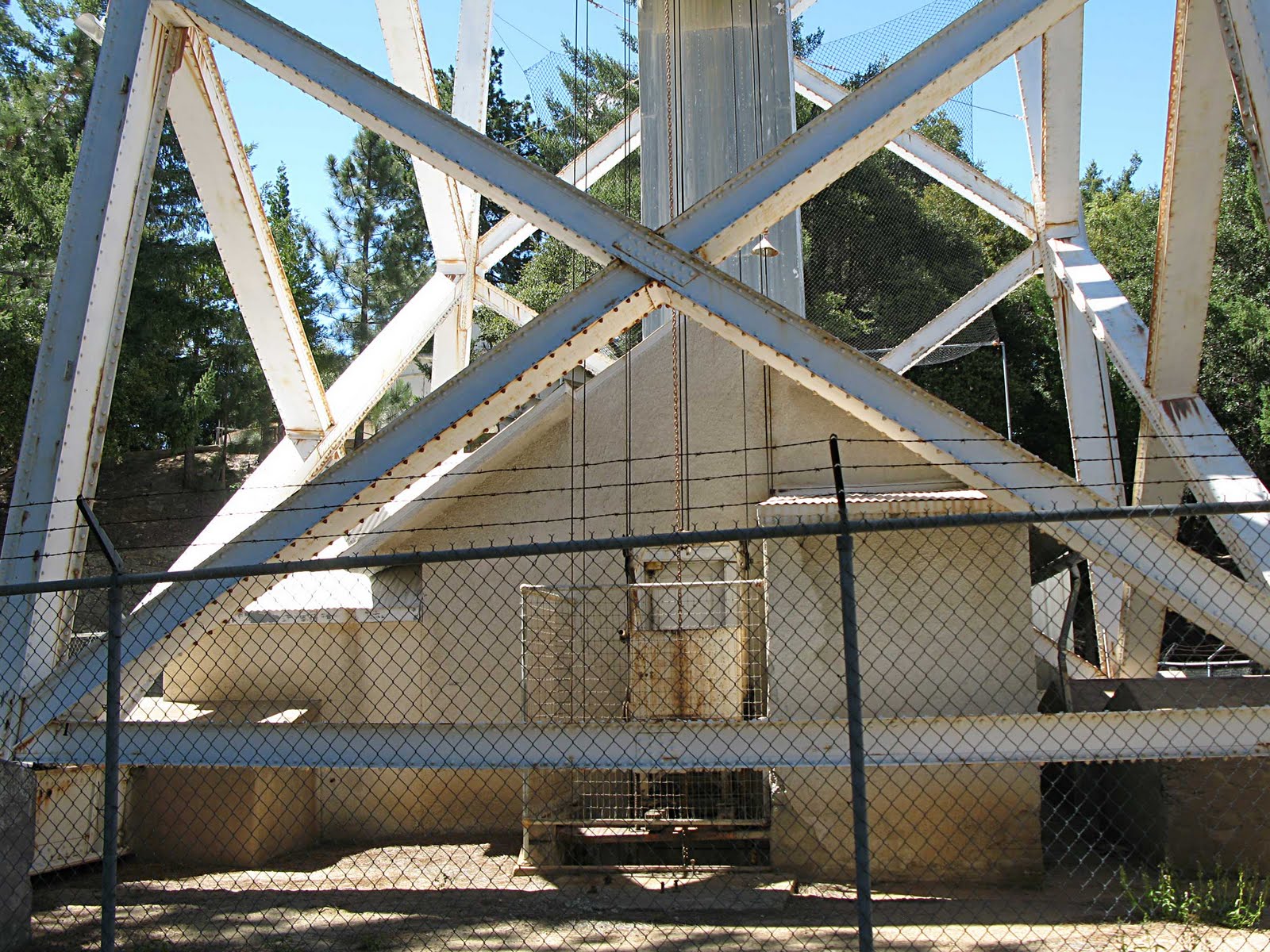
The Mt. Wilson Observatory started off as a solar observatory. George Hale, the founder with funding from Andrew Carnegie, originally did much research in the area of studying the sun's magnetic properties. While most people think of astronomy as looking at stars at night, astronomers have, and still do, study the the closest star we have during the day. That is, the sun itself. So, the scientists here do work in the day and at night. What you see above is the elevator that takes one to the top of the telescope. Many famous people and scientists have gone up it. When one examines the sun with one of these telescopes, one usually sees black spots on the sun. These spots are where intense magnetic activity (aka solar storms on the surface of the sun) takes place. There is usually an 11 year cycle for the sun spots. One major focus of studying the sun and the black spots is trying to figure out the exact mechanisms cycle and what produces them.

As I write this, much is being talked about in the news about the sun going into a "solar silence" phase where there will be little sunspot activity by around 2020. If that does happen then the question will be for how long, and what does that mean for us on the earth? We have not had this happen since 1645 to 1717, almost 400 years ago. I'll let you google the news articles and link some basic wiki articles for starters below.

The solar telescopes main instrument is called a magnetograph which takes the readings of the sun. Not only does it note the sunspots, but also the rotation rate of the sun. Also, each day simple drawings of the sun are made and sent to a couple of centers in the U.S. in an effort to predict extreme solar activity that can disrupt global communications.

As for me, the sun was making itself known to me in a bad way. The hike was easy while I was under the cool clouds, but once I got past cloud level things really warmed up. The observatories drinking fountains were not working, the little water and gatorade I had was getting warm, and I started to get a little concerned about the trip back down. Without liquids on a hot hike down could lead to a very bad situation! Yet, for the sake of science I pushed myself on to the the rest of the observatory.

Einstein Was Here! (Youtube Version)

I'll say this a few times as I do this. Personally, when it comes to science I would much rather read books and articles by scientists to understand the concepts. However, Wikipedia is a good starting point, but not the be all end all of understanding, be it science or any other discipline. With that caveat:

Sunspot (wiki article)

Maunder Minimum (wiki article)