Showing posts with label Aurora Ghost Town (East Pine Street). Show all posts

Thursday, December 08, 2011

Aurora Ghost Town (Mark Twain)

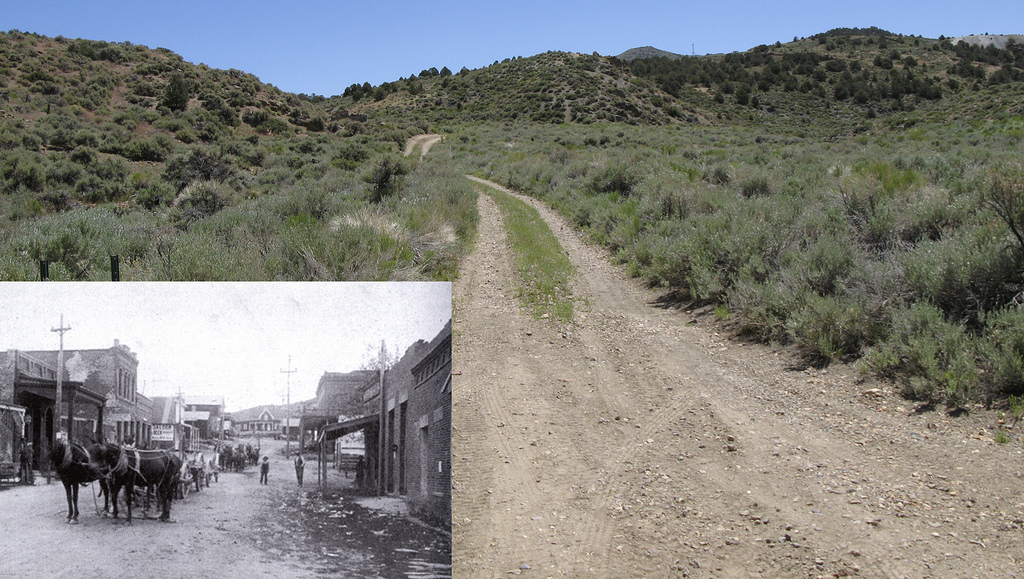
Heading back to the the fork in the road I headed off to the left side this time. This was still considered Pine Street.Further on down. Back in the day the sides of these roads would have had small cabins people lived in.
I was just checking out this interesting crag here.The most famous resident of Aurora, although very temporary, was a young Samuel Clemens. The future Mark Twain. He came here seeking riches in mining and milling in Aurora. He only stayed for a few months in 1862. This is because he soon realized that the physical labor and investing in mining was a little too demanding for him. He was remembered for being a good story teller, and it was during this time he started to transition into his real talent: writing. He eventually moved to Virginia City to start writing for the newspaper.
In the above picture I turned around. While at Aurora, Mark Twain lived at a few places, but one place he lived at was the cabin of Tom Howland. From what I can tell, that cabin would have been really close to here.


A lot more could be said about Mark Twain's time in Aurora. He did write about his time here in his autobiography titled Roughing It. His big story in that is how he and his friends should have made big money on a claim at Last Chance Hill, but they failed to register their claim in time. Another story that was fun to read was how he got stuck on one of the islands at Mono Lake. Something to keep in mind while reading his account, Twain loved to tell a great story and was not above exaggerating to make a good story. If I have some time at the end of the month I will show something he mentions in his book that was a few miles away from Aurora.
 
This marks the end of the second phase of this series on Aurora. The third and final phase deals with the cemetery back at where I started in the first blog. That will be next.

Aurora Ghost Town: East Pine Street (Youtube Version)

Wednesday, December 07, 2011

Aurora Ghost Town (The Daly Gang)

The long one. But, if you like westerns or western history this is it.

Something to keep in mind with Aurora is that it did have it's "Wild West" moments during its boom years and beyond, but those were for a limited time. It was usually peaceful with respectable citizens. In the Roger McGrath book which I have referred to before on here, and will list below as his book as the best on this part of Aurora history, only lists seventeen persons as the victims of homicide that can be verified. He does note that records are incomplete, and the number could be in the thirties based on a grand jury statement found in a newspaper at the time. Those homicides would have been during the boom years of the town, but it was during the period of about a year that a group of professional gunmen were hired that were the cause of a bunch of killings. They were known as the Daly Gang.

The following picture was taken around 1890 from a highpoint overlooking the northwestern part of town. The highpoint peak (Lover's Leap) was shown in earlier blogs, and the road I came down to the town from had a road that splits of to the west that leads to it. One of the things I wanted to do is take an identical shot of this picture from that highpoint, but ended up not doing it. There is always next time. :) In any case, this picture only reflects about 1/4 of the amount of buildings there were during the boom year period. The structure at the top is the Real Del Monte hoisting works building. It is on top of Last Chance Hill which is an important mining location for history in this blog entry.
Continuing from the last blog, I headed east along Pine Street until the road forked. I took the road to the right that was actually known as Wide West Street in Aurora. The next blog will cover the road to the left.

In the distance, up on what is part of Last Chance Hill, is a mining type of mound that is where the Real Del Monte Mining Co. hoisting works was at. I mentioned this above with the historical picture.
As I show you this mining area in the following pictures I want to give you some of the history of the Daly Gang. A young man in his mid-20's, John Daly, arrived in Aurora sometime early in 1863. He was already known as a gunfighter from Sacramento before arriving here. One of the key events that was already on his mind that played a big part in his downfall later on was that a friend of his was killed in Sweetwater Valley outside of Aurora. His friend stole a horse and was killed by a man to get the horse back, but the station keeper, William Johnson, would not tell Daly who killed him. Daly was very angry about this and wanted to avenge his friend. He would not forget about this incident.
Meanwhile, there was a dispute between the Real Del Monte Mining Co. and The Pond Mining Co. over claims on Last Chance Hill. A legal battle was going on, but both sides hired gunmen to protect their interests. John Daly and his friends were hired as the gunfighter enforcers for the The Pond Co. Not only were they to protect The Pond's interests, but to intimidate witnesses and the opposing company executives. They were known as the Daly Gang.
To achieve more power, Daly had one of his men voted in as the City Marshall during the election. This created an interesting situation. Daly and his men were now running around as law enforcement marshals. The criminal element of town had taken over as the law, but the average citizen was relatively safe. As was fairly typical of old west towns, as long as the rough crowd fought against each other no one cared, but if someone respectable was killed then the town would rise up against the individuals.

The Daly Gang had pretty much taken over the town. Although I like to compare this to the situation in the movie High Plains Drifter being as it was filmed not too far away, most of the citizens continued their daily lives without fear. While the average citizen was safe from criminal activity, the vices of an old west town did increase during this period. This is because the Daly Gang began collecting protection fees for themselves that allowed for more gambling, prostitution, public drunkenness, and fighting. So, they were acting more like gangsters than law enforcement officers during this time.
The above picture is looking at where the Real Del Monte hoisting works building would have been that I mentioned earlier.

Eventually, in the early part of 1864, a second trial between the two mining companies reached a hung jury. It was then that a settlement was reached between the two companies. Because of this there was no longer any need for hired gunman. So, the Daly Gang was no longer employed by the company. Meanwhile, while John Daly was protecting his clients during the trial in Carson City, a new marshal was elected. This new marshal fired all of Daly's men and created a new police force.

John Daly and his gang really had no reason to stay in Aurora anymore. However, there was one vendetta that had not been resolved in Daly's mind. That was the issue regarding William Johnson not telling him who killed his friend a year earlier. Since the name was never revealed to Daly that meant Johnson was going to have to pay for the killing since he was the one covering it up. He was now the target of the Daly Gang.

Johnson showed up in Aurora selling some potatoes that he had grown near his station. Members of the Daly Gang noticed him in town and started stalking him. That night Johnson was befriended by members of the gang at the Merchants' Exchange Saloon (part of the hotel). Note that this is the incident I was thinking of, and the place I refer to, in the previous video when I mention they committing a murder here, but this is just where they met up with Johnson. By the time the saloon had closed, Johnson had been drinking and gambling with the men. They took him to another saloon.

After 4:30 a.m., Johnson started walking down the street. As he was walking up Antelope Street near the post office, he was attacked by William Buckley, Three-Fingered Jack, James Masterson, and John Daly. Daly shot him through the head clearly killing him, but Buckley made the deed absolutely certain by slashing his throat with a bowie knife.

In one of the first blogs on this I showed a picture of Antelope Street heading south. I am going to say that the incident took place maybe 50 feet (?) or so down the road of where I was standing. You can right click and open in a new tab to see this picture HERE.

As I mentioned earlier, when the gunfighters killed fellow gunfighters no one cared, but once a respectable person was killed then the town rose up. That is what happened here. The town went into a panic and quickly formed a "Citizens' Safety Committee" at Wingate Hall.

A few complications arose during all of this, but the main one was that William Buckley escaped the town. Two posses were sent out after him. Four days later he was found near a cabin where Rush Creek enters Mono Lake. For you movie fans, yes, this is very close to where Lago was in High Plains Drifter. Also, Rush Creek is connected to that Gem Lake hike I did last year in November.

Back in Aurora the town was now under marshal law. Fearing that Daly and the men would escape justice if they were sent to Carson City to be judged in court, they decided to act. The four men were hanged on February 9, 1864 in front of Armory Hall above town. The next day Governor Nye, a U.S. Marshall, and a few others arrived. They were disappointed to see vigilante justice had happened, but the town was very quiet and orderly.

Summing this one up, the Daly Gang rose quickly and then had a quick decline in about a years time. After they were over with, the town went back to being a peaceful. At this point, the Aurora was beginning to decline as the final year of its mining boom.

Most of what I described here is based on the Roger McGrath's book which covers the violence in the towns of Bodie and Aurora. Chapter five is the one that details the history of the Daly Gang. Obviously, he goes into a lot more detail. It is highly recommended:

Mcgrath, Roger. Gunfighters, Highwaymen, & Vigilantes (Berkeley: University of California Press, 1984)

In the next blog, I will cover the most famous resident of Aurora.

Aurora Ghost Town: East Pine Street (Youtube Version)

Tuesday, December 06, 2011

Aurora Ghost Town (East Pine Street)

For the next couple of blogs I will show you what the other side of Pine Street is like these days and give you more of the history of the town. This is looking toward the east side of what would have been the main street of Aurora.Near the point I am at there would have been a flagpole with the American flag. On the left side closest to me would have been the Gem Saloon. Further on down would have been places like the Wingate Saloon and the jail. Just to my right would have been the location of the Exchange Saloon.

Keep in mind this is different than the Merchants' Exchange which also had a saloon. One correction that I think I need to make here is that I think the gunfighter William Carder was actually killed here and not where I say in the video about the Merchants' Exchange. Although, the irony is I was probably standing a lot closer to where he was killed with my back within feet of the Exchange Saloon site. There is some ambiguity on this in the books I have. Then you have other saloons with similar names too. Carder will come up again in this blog at a later time. I'll explain a little more as to why I made this mistake at that time, and if I find out anything different I will re-edit this.

The superintendent's house would have been in the background near where the road forks...we will get to that...for now you can see it in the background in the historical picture I put in this one:
Moving to the east and then looking north is what I was referring to in previous blogs as the craggy cliff. The armory I was referring to in earlier blogs would be above that, but I think it is more to the right side of the picture. Again, it was overlooking the town in order to protect it.
Moving more to the east, but then turning around and looking west gets us close to the courthouse. That would have been close to my left, and that is the courthouse remains for that time on the left side in the historic picture below. The courthouse actually turned into a hotel later on.


Let me say this now that in the video for this part that I was really close in mentioning where some of those buildings were by the courthouse, but had I done that video now I probably would have had it a little more fine-tuned than how I describe it. It's nothing that most people would care about, but the depth of how far things are away is a little more complicated here. It is not like the Alabama Hills where I have the background, rocks about half-way, and then close-up rocks. Aurora does not give me much to work with. This is mostly using a background and then an annotated map. Maps like the one I was using just give you some guidelines at a place like this. I am not saying it's impossible. It's just more complicated compared to something like the Alabama Hills.

This following picture is looking more to the left to show you where a lot of people would have been living. Again, it drops and has short inclines. Most of the other roads of the town would be over that incline. The remains of other homes, the schoolhouse, stores, and churches can be found out there, but I decided to stick with the mainstreet for this one. There is always another trip. :)

After walking a little further to the east one comes across this shack.
This shack seems a lot more "modern" than the era I have been talking about.
In the next two blogs I cover each road of where the main street forks into two.

Aurora Ghost Town: East Pine Street (Youtube Version)