Showing posts with label Aurora Ghost Town. Show all posts

Monday, December 05, 2011

Aurora Ghost Town (The Stamp Mill Remains)

From where the Merchants' Exchange Hotel would have been I went down to one of the remaining artifacts you could see in the distance. I then turned around and took a picture of where I was just at:Then I wanted to show how far I was from the other reference point, the wall, in the distance.This is part of an old stamp mill that was used here. On the metal parts down below it states, "Risdon Iron Works SF CAL 1896". So, this was much later than the mills used during the 1860's.

There is one thing I should add to the above that I did not mention in the video. The actual site was used as a a foundry, blacksmith shop, and a stamp mill. It was owned by a G.W. Coffee going back to 1863. So, the remains below go back to 1896, but the site itself was used for one of the mills going back to the boom years. There were around 17 stamp mills at the time in Aurora.
I went back close to where the Exchange Hotel would have been and tried to get close enough to where the main street, Pine Street, would have looked going east. The next blogs will cover the east side of the street.


In the above picture you will notice some other trucks came down and parked at the main crossroads. They certainly had the right to do that, but it was disappointing that they arrived just when they did. I meant to take a longer alternative video than what I used at the crossroads. However, since they parked right in the spot to do that it was not worth doing anymore. I am okay without it, but it was frustrating at the time to be out in the middle of nowhere and people come to take my obvious picture and video spots.

From the above picture I moved forward heading back to the main crossroads. I encountered a brick foundation. I mentioned in the last blog that brick was the primary material used in Aurora and not wood. Unlike Bodie's remains of wood, Aurora's downfall for the modern historian was because it was made of brick. Way after Aurora became a permanent ghost town in the 1920's, sometime around the WW2 era of the 1940's, companies and other people came to this ghost town to scavenge it for the bricks. That material could be re-used elsewhere. While tourists did come and take things, the main reason nothing is left today is because of the valuable brick it was made of.

So, you can find the remains of bricks like this around. A good reason we have a good portion of Bodie remaining these days is because of the lesson learned from what happened at Aurora. It is one of those things that, for me, hurts to think about. I have read one or two accounts of people that had once lived here, had no idea what was going on after they left, only to be very shocked when coming back to visit.

What would have happened if no one took anything? Well, the brick material was still a product of its time. Over time the weathering forces of nature would have had an effect on the bricks and other structures holding up the buildings. So it would not be the case one could come to a 21st century fully intact Aurora. More than likely, they would have decayed and come tumbling down. However, we will never know exactly what would still be remaining. We still would have had something more than today. If the historical concerns of today had been around then much more could have been preserved. It's too bad, but in many ways the Bodie tourist has much to thank for the Aurora legacy. Yet, most people that visit Bodie have no clue about Aurora.

Aurora Ghost Town: West Pine Street (Youtube Version)

Sunday, December 04, 2011

Aurora Ghost Town (West Pine Street Cont.)

(GPS: N38 17.200 W118 54.145)

In the last blog I pointed out where the Merchants' Exchange Hotel would have been and in this one I get very close to where it would have been standing. As I approached where the road would have continued you will notice the slight rise in elevation.I went down the side and looked back toward the east. You can see the wall in the distance.This pile of wood remains is nearby. It turns out that many of the buildings used brick and not wood. I'll get back to this in the next blog because it is the main reason why none of the buildings are still around.Looking back to the east again from the higher elevated area near the wood.Looking toward the west. Keep in mind there would have been many cabins and homes built all around. I am just focusing on the main street where most of the action would have taken place.
More to the north. There is another artifact that is a good landmark that remains. I'll get to that in the next blog.
Aurora Ghost Town: West Pine Street (Youtube Version)

Saturday, December 03, 2011

Aurora Ghost Town (West Pine Street)

(GPS: N38° 17.200 W118° 54.055)

Imagine a square grid with roads and that is the way Aurora was mapped out. However, most of the roads within that grid are at different levels. So, back during the time of this town you would have to gain or lose some elevation traveling around town. Maybe not too significant, but trying to imagine where buildings were on some of these roads is a little different than what you see at Bodie.

In the next picture I am at the main crossroads of the town. I would say it is slightly north of the center of town. I am looking south here, but the main street of town, Pine Street, intersects the road running east and west here. In the next few blogs I will be covering the west side first and then the east side.
Now turning around back to the north you can see the craggy cliff area I mentioned in the previous blog. The armory would have been up there on that side overlooking the town. You can see a vehicle parked on the left. Most people park there when they come here. Oddly enough, that person came alone and was looking for birds from what I could tell. At least he was making bird calls for them. It was kind of annoying because we had to purposely evade him so he would not show up in the pictures or video. He was still there when we left. This is the wall that I showed some of in the previous blog. I think I have read that it might have been part of the bank. I can't remember right now, but its importance is it makes a good reference point while exploring the area.
Turning a little more to the left from the above picture will give us where the west part of Pine Street would have been. The sagebrush has completely covered the road, but you can see traces of where it once was. In fact, if you use above GPS coords with satellite maps you might be able to make out this part of the old street.
In this direction the Merchants' Exchange Hotel would have been. It was used as a hotel, a saloon, and a restaurant. There were a bunch of saloons in this town. The Daly Gang got into a bunch of gunfights that usually started and ended at them. The Merchants' Exchange played a part in one of the killings. I will comeback to the gang in a later blog.
In the above picture you can see the remains of the Merchants' Exchange Hotel. It is the last building on the left in the background. The original caught on fire, and this one you see decaying was the rebuilt one. It is difficult for me to describe where it was, but it is important to notice in the artist's depiction that Pine Street runs right next to the second level of the building.

In my picture below, you will notice the dirt road heads to the right. However, Pine Street would have been very close to continuing straight into the middle of the picture. Again, the sagebrush overgrowth now covers that up.
I'll head out to close to where the Exchange would have been in the next blog.

Aurora Ghost Town: West Pine Street (Youtube Version)
Friday, December 02, 2011

Aurora Ghost Town (Overlook)

(GPS: N38° 17.435 W118° 54.010)

This begins another series that has been a long time in coming. I've been sitting on the pictures and footage of this for quite some time. I guess you could say that it is a sequel or prequel, depending on how one looks at it, to my Bodie series of blogs I did a year ago. In this blog I just intend to give you an introduction to the next few blogs on this.

Aurora Ghost Town is in Nevada. It is not too far from the California state border. That was one of the early disputes they had in the town because at one point it was thought to be in California until they did a surveys of the California and Nevada borders. As one enters from the north side of where the town was there is a rock that has a sign. You can right click and open in a new window if you want to read what it says about this on the sign:
There is another sign not to far from the rock. This one tells you to not to take anything you find at this ghost town. The sad truth is that sign is really too late.Aurora is my favorite ghost town based on the history it has and its remoteness. The problem is there is nothing really there these days. Most of the materials the town was made of were ransacked long ago. I'll get into why this was the case later, but I think what happened here was rather tragic. From what I have seen in old pictures the town was very beautiful. These days it has been reduced to fields with the foundations of some of the buildings and rubble around.

Normally, I do not like to present open fields with nothing left. There are some traces of how the town was, but in some ways it is disappointing. However, since I love what this place once was and it is fun to go there, I am going to do my best in giving you an idea of how the main part of this town was.

The truck we came in on was parked by where the above pictures were taken. The trick to getting to Aurora is you really need a 4WD or a high clearance vehicle. A word of warning on this, Aurora is a remote place and there are a couple of dirt roads to get here. Some are easier than others, but you do not want to get stuck out here. Civilization is NOT in walking distance, and you run the risk of not seeing any other person while you are here.
One can take your vehicle into where the town would have been, but from where we parked we just walked down the dirt road until we started to overlook the town.
This is panorama getting close to overlooking where the town would have been:
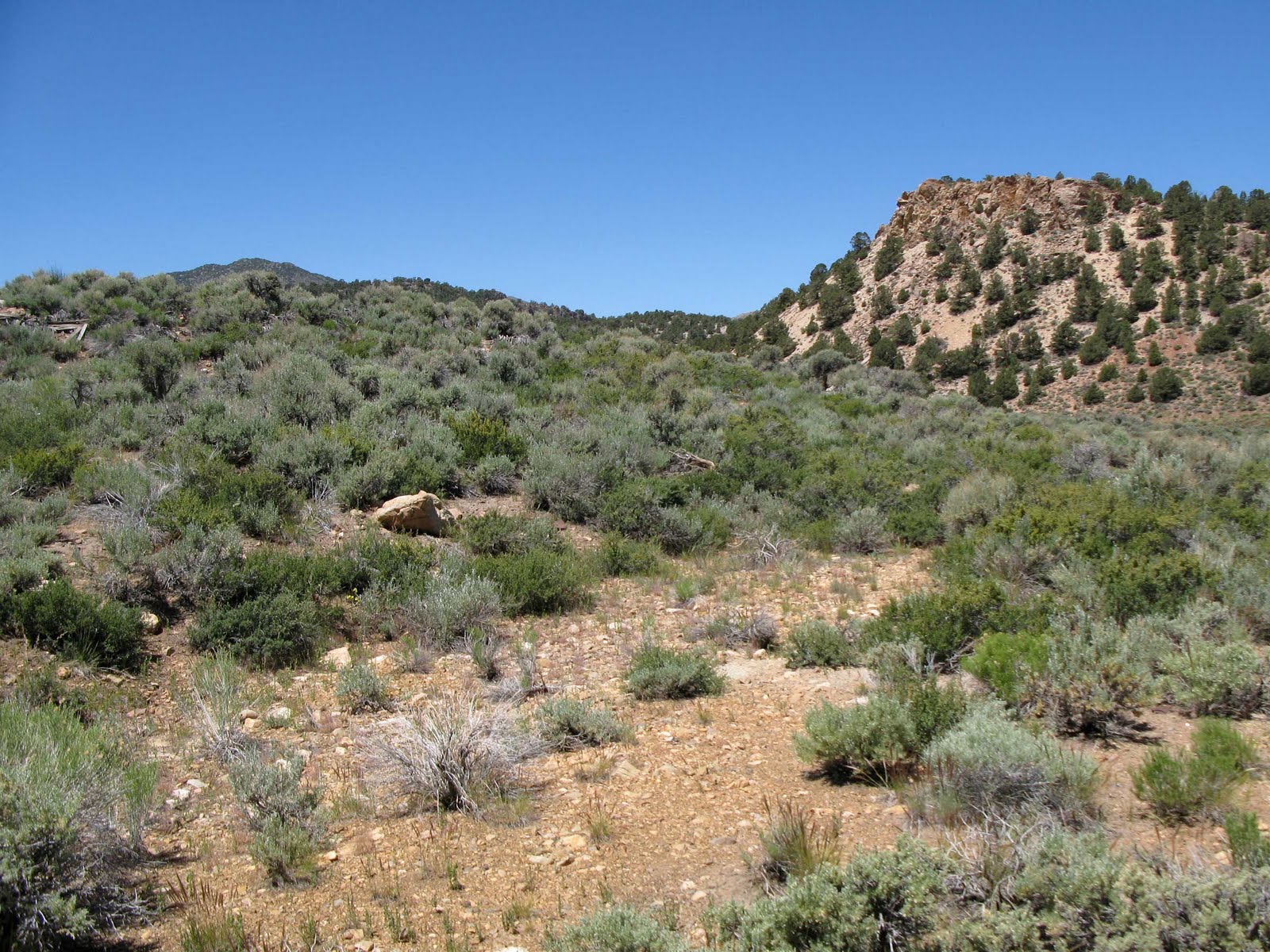
The road you see in the middle of the pictures intersects what would have been the main street of town which I will be showing in the next few blogs. Just to the left the of road in the above picture there is an area that has a cliff that overlooks the main street; if you look closely the cliff starts to connect into the middle of the picture. This is where the armory would have been. I'll get back to this in a moment. In the above picture and the one below, we are looking toward the south from the north side. As you can see, there really is nothing here. That wall and a few other structures are all that is once left of this town. In the above picture, just down below and right in front of that wall is where the main street would have intersected the road we were on.

I'll give some of the history as we go along, and will mention some books at the end of the series that go into a lot more detail. Aurora, like Bodie, was a mining town. In August of 1860, a few men found gold and silver in a rock outcrop in the background of the above pictures which was called Esmeralda Gulch. Esmeralda was the name one of the men used because he had just read Victor Hugo's The Hunchback of Notre Dame. In the years that followed Aurora quickly developed into a major town with a population of a few thousand people. Somewhere in the range of 3-4,000 people, but some would say more than that. For an area like this and at that time, that was a lot of people.

The boom years of the town were really during the years that the American Civil War was going on. Really it was from 1861-1864 that the town really grew with many coming to make their riches here. The bulk of the gold and silver were produced in 1863-1864 when the mills were in full force. Thereafter the boom was over and the population dwindled until it reached less than 200 in 1890. There were some revivals of mining, but by 1920 Aurora was a permanent ghost town.

I mentioned the armory that overlooked the town. A militia group was maintained for the possibility of any hostilities. There was the possibility of issues relating to the Civil War that could cause a conflict in the town, but the more obvious issue was the possibility of Indian attack. The Owens Valley War between the ranchers and the Paiute Indians was going on around the same time as the boom years and the Civil War. Nothing ever happened regarding that, but the militia was used once in an infamous incident which I will get to.


Aurora Ghost Town: West Pine Street (Youtube Version)